Wednesday, February 25, 2015

Serendipitous Sighting - A visit to Tadoba Andhari Tiger Reserve


“Aapko Dikha?”, “Nahi, dusri gypse wale bata rahe the unko dikha, aapko dikha kya?”, “nahi hame bhi nahi dikha”

This is a recurring discussion, happening whenever another 4x4 passes by in the jungles of Tadoba, as we crisscross the jungle to see the elusive Tiger. This is our second safari of the three we booked and the only one in the evening. Freezing cold in the morning makes us believe that the Tiger is not going to come out of its resting area and this is our only chance to see the Tiger.

Located 30 kms from Chandrapur, and 150 kms from Nagpur, Tadoba – Andhari Tiger reserve [TATR] is the oldest and largest in Maharashtra and covers an area of roughly 630 square kilometers.


We decided to spend a weekend in Tadoba and booked three rides from Moharli gate, which allows a maximum of 30 vehicles per shift and reports maximum sightings out of 5 gates at Tadoba.

We reached Tadoba the previous night and stayed at one of the newly set up tented accommodation – United 21 Tiger Camp. The beautiful tents with amenities do not help keep the cold away and more so when the news reaches that Nagpur has recorded the season’s low of 50 C. and Tadoba would be cooler by about 2-3 more degrees. A quick tea, followed by adding layers of clothes on our body, makes us a little comfortable as we await dinner in the tented restaurant. Chicken, Dal, Rice, Vegetable, Roti, Papad and a dessert – we are more than happy to settle for the night with one thought – will getting up at 4:30AM the next morning be all worth it?

The rules for arranging the vehicles have changed recently and the hotel manager is confused. With some calls and asking around, he manages to get two 4x4’s for 6 of us and we quickly settle in to make a 3 kilometer dash to the main Moharli gate.

It’s still pitch dark, when we make our way to the forest office to show the ID cards and the permit – registered online two months ago. We join a long queue of vehicles – all open 4x4’s as everybody awaits the clock ticking slowly to hit 6:00AM, when the gates open in winter.


At 8:30AM, restlessness sinks in, two and half hours in the jungle has yielded nothing but few common birds, a bunch of monkeys, spotted deer and occasional sambar. The enthusiasm is wearing out. Our guide painstakingly tells us the history of this place and explains the various zones, problems of the park and that occasional state transport bus which still crosses the park to make its way to district HQ of Chandrapur. 


 At 10:30AM we head back from wherever we are, disappointed to not have spotted the tiger. On the way back till the gate, the guides tell us this could be because of the spell of rainfall which the park witnessed three days ago.

Breakfast is ready at the hotel when we reach and that is followed by a quick Vegetarian meal after which the 4x4’s are ready again for the evening safari. In the second safari, we have seen most of the mammals for the second time, we now know which route we are going to take and what we will be seeing next. The only change is an occasional owl or eagle, which we did not spot in the morning. Heart sinks, when a 4x4 stops and says, “Subah jate waqt teen gypsy ko tiger dikha, Sonam raasta cross karke jhadi mein gae hai, kill udhar hai” (Three vehicles saw tigress Sonam this morning, the tigress crosses the main road and went in the bushes where they suspect she has killed an animal)

Tigers are named across National Parks, while Bandhavgarh has had Charget, Sita & B2, Ranthambore has had Machli. Tadoba, which is home to around 60 tigers as per our guide, has Sonam, Tara, Maya, Gabbar, Yeda Anna and many more…

Day two ended with another sumptuous round of food but disappointment about the tiger. Next day would be our last safari in the jungle, before we head back to Nagpur. As if it was a routine, the entire family was up and ready at 5:30AM in the chill – thanks to the hotel being on the banks of reservoir of Erai Dam. The 4x4’s made their way to the gate again, as we did the now familiar process of identification and waited for the clock to strike 6AM. The guides had a different plan today, to first show us the Andhari river and then start the regular circuit with first visiting the Telia lake, followed by other areas.


As we entered the Telia lake area, we saw a bunch of vehicles and excited tourists pointing towards the other bank of the lake. “Udhar hai, pathar ke upar, jhadi ke niche” ( there she is, just above the stones and below the grassland) was the first intimation that we are going to see the Tiger. Little straining of eyes and using binocular (10x50) gives a complete picture of the majestic Tigress- Sonam, resting near the lake. “arey apne paas dekh rahi hai” (she is looking at us) says the next voice from another vehicle as the morning calm is filled with umpteen camera clicks from everybody all around. More 4x4’s join in and the jostle to find a vantage point leads to the forest department vehicle ordering all vehicles away.

As we start moving, Sonam stops to drink water and then crosses the lake from the shallow area to come over to this bank – only to disappear in dense forest there on. As irony would have it, the person with longest lens to his camera has to be helped to see where the Tigress is!


The day here on is spent in searching for more Tigers around the park, but as the guide had said on the first day, “chehra dekh ke hi pata chalta hai, inko tiger dikha ken ahi” – You know if the person saw the tiger or not by looking at his face. Our faces have lit up as we criss cross the park yet again. Half an hour before the park closes, we make another dash to Telia – hoping that Sonam the tigress has decided to roam around a bit and explore some more area. Back to the hotel, the feeling is of an successful trip as we pack and make our way to Nagpur !

As has been the case before, every trip to the jungle ends with a plan of making another trip to another jungle !


Best Season: For maximum sightings, the best season is summer – when tigers come near the main roads and sit in the waterhole which is serviced by tanker. However, summers can be harsh with temperatures exceeding 45C daily. Weather wise the best season is from February to April.

Safari: The safari bookings open 60 days in advance and need to be booked online. The bookings fill up very fast. Maximum vehicles are allowed from Moharli gate. The park is closed on all Tuesdays. There are two safari’s a day.
The permit costs INR 1265 for a maximum of 6 people and the cost of guide and 4x4 is additional which is to be paid before the safari starts. Rules change often, but currently it was INR 2300 per safari.

Connectivity: Nearest Railhead is Chandrapur (30kms) on Delhi – Hyderabad / Chennai line and nearest airport is Nagpur (150kms). The resort can arrange a taxi for pick up. Alternately taxies are available at Nagpur Airport.

Accommodation: There are ample accommodation options at Tadoba near all gates. The MTDC property is closer to Moharli gate. We stayed at United-21 Tiger Camp, an upcoming property, which currently has 20 luxurious swiss tents. The cost was INR 3000 per person per night on twin sharing inclusive of all meals. 

About the authors:
Priyanka Sharangpani - Joshi is a lawyer by profession & a passionate traveler. Priyanka is founding partner at Lex Credence, a law firm based out of Pune. She dreams of visiting all continents in the next 10 years!

Ameya Joshi is a Management professional who dreams of completing atleast one Round the world trip and loves to personally route each trip. His dream destinations Moscow & Istanbul already visited, he now tries saving for a trip to Tahiti.

Both of them are looking for sponsors for a Round the World Trip.

Tuesday, February 24, 2015

Leading the pack yet again - IndiGo now corners 36.4% market share

Summarizing 2014
2014 was a year of mixed emotions for Indian Aviation. The industry returned to growth after a brief hiatus post the fall of Kingfisher Airlines and in the latter half of the year saw reduction in prices of Aviation Turbine Fuel (ATF) on global cues.

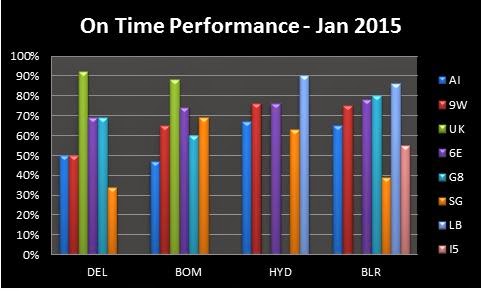
With this came the unprecedented but widely forecasted crisis at Spicejet, after few steady months. The year which started on a good note for Spicejet, having performed better than IndiGo in its much touted On Time Performance (OTP) ended with one of the worst performances on the same parameter for the airline, recording a low of 47% on time departures at Delhi in December’14.

Go Air, launched a new station – Bhubaneshwar and deferred delivery of its 20th aircraft, Air Asia had muted performance with expansion nowhere close to what was being discussed and published.

Jet Airways was resurgent with funding from Abu Dhabi’s Etihad and subsequent changes, while only other Full Service carrier Air India had its own share of problems with the technical glitches on the Dreamliner’s and engineering issues on the Narrow bodies yet made it to Star Alliance.

Well, that leaves us with IndiGo – which continued to expand with more flights between metros and launching flights to few more domestic and international destinations. The airline also, for the first time decided to induct aircraft available in open market as a stop gap arrangement till the A320 NEO are inducted.

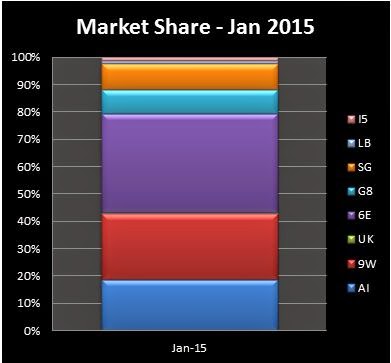
IndiGo continued to be a market leader, closing the year with a market share of 31.8% followed by Jet Airways and its subsidiary Jetlite at 21.7%. National carrier Air India garnered 18.4% while Spicejet cornered 17.4%. Go Air failed to breach the double digit mark and ended the year at 9.2% with Air Costa and Air Asia closing at insignificant 0.9% and 0.5% respectively.

2015 begins
Passengers grew 21.33% MoM in January 2015, an indication of return of good times and assertion that growth in capacity is followed by growth in passenger numbers.

The year started with news of change in ownership at Spicejet and launch of Vistara. Both will have an impact on the market in these 12 months of 2015. However, at the end of January, Spicejet was still struggling to get its act in order with an On Time Performance (OTP) of just 34% at Delhi in January. Indeed most of it was affected by fog, but it wasn’t fog alone which led to this performance.

The OTP remained an issue for all airports across the country due to the fog in North & East India which was around for a prolonged period than yesteryears. Normally unaffected stations also saw fog this year which compounded the problem.

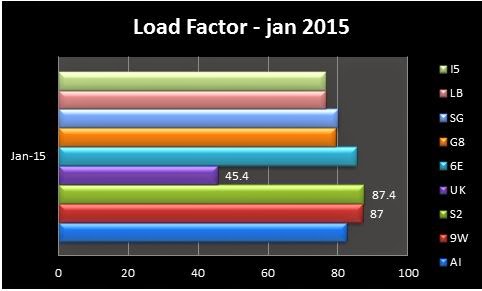
January 2015 saw a total of 62.45 lakh passengers taking to the skies, with the month clocking marginally lower Load Factors than December 2014.

Jet Airways clocked the maximum load factors of 87.4 percent for flights operated under Jetlite code (S2) and 87 percent for those operated under Jet Airways (9W), while the lowest load factors were clocked by new comer Vistara which recorded 45.4 percent. Vistara did not have complete month of operations and this was its first month, thus this is too early to judge the performance.

Spicejet saw maximum cancellations and also maximum complaints – a trend that should reverse very soon as funding is tied up and operations are back to normal.

IndiGo continued to outperform competition in market share as well as On Time Performance with overall On Time Performance of 73.3% and a market share of 36.4%. Spicejet had the worst On Time Performance with less than 50% of its flights being on time. This is largely due to its performance at Delhi being hit to a low of 34%.


Go Air has seen its market share slip from over 10% which it achieved twice last year to less than 9% now. With no addition to capacity, the airline will find it tough to hold on to the market share. However, the airline continues to have some monopoly or duopoly routes which the competition is not after. This is either due to slot constraints at Mumbai or the leaders fighting it out with the newbies in the market.


Challenges Ahead
2015 will be a challenging year, Vistara would be flush with funds to expand and Air Asia would be hoping to get back on track with newer routes, planes and a massive expansion if they have to sustain. So far it looks like IndiGo has been able to contain them and made them re-think on the plans they had. Jet Airways will continue its expansion to its middle eastern hub of Abu Dhabi with flights from Ahmedabad and Pune on agenda effective March. This year will also give us an answer on the European hub strategy of Jet Airways.  Spicejet will get its strategy in place with respect to Q400 and B737 and will have another “NEW” network this year.

If all goes well, by year end IndiGo may receive the all new A320 NEO. Spicejet would hope to stabilize the network and operations in first half of the year and take a decision on the Q400s by mid-year. Go Air could well be the next airline to start international operations, most likely a short hop from Mumbai or Delhi.

Lastly, the government will have to get its house in order and iron out differences on the revised Route Dispersal Guidelines and revise the 5/20 rule at the earliest. The battle for Noida airport will increase from here on and so would this be a critical year for Navi Mumbai. Any delay now, will mean the airport opening certainly gets pushed post next general elections

I can only hope for a great 2015 for Indian Aviation !


Monday, February 23, 2015

Aero India 2015 - Photo essay


Signs of Positive changes - Jet Airways from Pune to Bengaluru

I decided to jump jobs in Jan, which meant I was relatively free till I join the new assignment and take a day off to visit Aero India. I firmed up on Feb 20th and 21st as the days I would be at Yelahanka and proceeded with bookings.

Bengaluru from Pune opens up unlimited options across the day, with frequencies led by IndiGo – 5, Jet Airways & Go Air – 2 each, Spicejet & Air Asia – 1 each. To reach well in time and make it to Aero India – I decided to take up the first departure from Pune, the 0545 Jet Airways flight. This would also be my first after the airline moved to an all FSC model. The old flight number 9W 2363 is retained, which once indicated the LCC wing of the airline.

This is one the older flights of Jet Airways and for a brief period in 2009 operated by ATR. This rotation operates as PUNE – BENGALURU – KOLKATA – GUWAHATI – JORHAT / IMPHAL – GUWAHATI – KOLKATA – BENGALURU – PUNE.

Booking
I decided to download the Jet Airways mobile app to process my booking. The experience was new and good. Just that the app closed immediately after the PNR was generated. I received the tickets in my mailbox in 10 minutes.

About 23 hours to departure, I logged in and did a check in from the app, which again was effortless.

Check-in, Boarding & Airport Experience
I reached the airport at 0425, about 1:20 mins to departure and the standard two CISF checks at Pune led me to the check-in area. I only had a hand baggage and thus made my way to security. Within 7 mins of getting dropped off by the cab, I was in security hold area. The benefits of a small airport in a city like Pune!

I carried printout of the boarding card and thus did not visit the counters. The airline ground staff reached the boarding gate around 0500hours as soon people formed a line. Boarding started early and we were seated by 0525.

At this time, another Jet Airways ATR to Hyderabad was getting ready while two IndiGo birds were parked next to us which would make a trip to Chennai & Kolkata respectively. Spicejet aircraft arrived from Sharjah, which would then turn around for Bengaluru.

The aircraft was non Boeing Sky Interior (BSI) bird with yellow lighting in 12 business class seats and 156 economy. The loads were brilliant with 11 out of 12 seats occupied in Business and almost all occupied in economy.

Inflight & Meal
Doors closed at 0540 and we pushed back on time and were holding before entering active, probably for clearances since there was no other movement at that time of the day. We soon entered active runway 10 and took off in easterly direction, banked right to reach cruising altitude.

The seat belt signs were soon switched off and the meal service started. The meal consisted of a Paneer Roll or a chicken roll. I opted for the later. The tray comprised – the snack, a bottle of water, kitkat, the famous Imli and AVA discounted items card.

The meal was not adequate for that time of the day. I would have preferred tea/ coffee with lighter snack rather than chicken roll which wasn’t upto the mark in terms of taste.

There is a lot that the airline needs to do in terms of food improvements.
The aircraft on the other hand was clean. Not just the seats but also the windows.

Deplaning
We landed on runway 09 at Bengaluru and taxied to one of the aero bridges. Since the flight was going onwards to Kolkata – security staff at the gate checked our boarding passes before we set out.

Overall Verdict
In the last few months, Jet Airways is improving in leaps and bounds. I had an opportunity to connect with the top management with few suggestions and the promptness with which they were responded too along with the way of response was commendable.

The airline needs to work towards fleet standardization and improvements in food. The last year has seen it become number 2 in On Time Performance at all airports and in few months leading the pack too.

Will I fly Jet Airways again? – I think I will, costs matching the competition, good timings and Frequent Flier Program points – make it an attractive option.

Flight Summary
9W 2363 Pune to Bengaluru
VT-JGK B737-800 (WL)
MSN: 32579
13.3 years old
Configuration: 12J / 156Y
STD: 0545; ATD: 0545
STA: 0710; ATA: 0700

A delayed Air Asia India experience. Are they taking passengers for a ride?

Air Asia India (IATA:I5) has been operating in Indian skies from June 2014. Personally I have not been impressed by their overall strategy, plan and operations. From the selection of its hub and then moving it, to having a serious foot in mouth syndrome when it comes to declaring profitability predictions and fleet induction strategy. Nothing has gone as per what was published or planned.

I always wanted to fly the new airline, which now has a fleet of just three A320s, all with Sharklets, leased from the parent in Malaysia. The airline launched Pune operations in December 2014 with flights to Bengaluru and Jaipur. As I made my plan for Aero India 2015, I decided to return early but try out Air Asia.

Booking
Effortless booking experience on Air Asia website, which is common for the entire group and not country specific. I find the websites of SpiceJet & IndiGo clutter free as compared to the home page of Air Asia. Quick selection of seats, in which I choose the first free seating, 8F followed by meal selection – Rs. 150 for a Masala Omlette and I was done. The ticket was quickly in my mailbox.

The airline allows check-in up to 14 days in advance and I did not know this. The airline sent an email mentioning that my flight was open for check-in. Indeed very helpful.

The Fiasco!
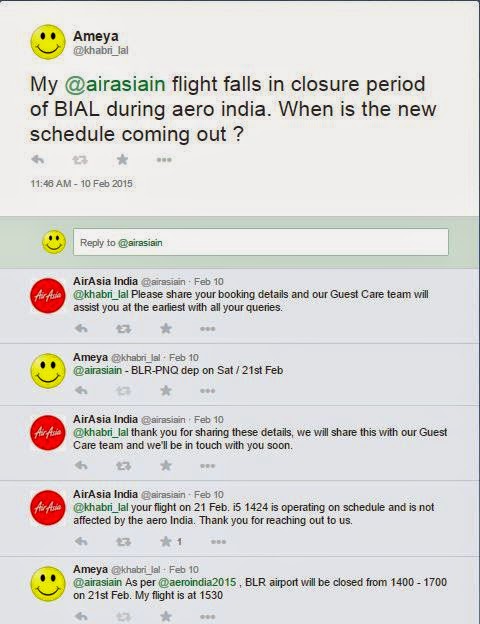
As I booked the ticket, the flight was showing as a departure of 1530 from Bengaluru (BLR) arriving into Pune (PNQ) at 1700. Going by the past experience of air space closure at Bengaluru, I cross checked on the air space closure. The airport website had official information that airspace will be closed from 1400 – 1700 from 19th February to 22nd February which happens to be the air display time at the Aero Show.

I tweeted tagging Air Asia asking if the flight would change. Since Pune airport is closed on all Saturdays from 1100 – 1700 hours, I was sure the flight could not be advanced, it can only be delayed. Yet there has to be a confirmation. As all other airlines continued adjusting the timings, Air Asia did not !

My twitter interaction with the Air Asia team was as below,

After this I got a call from Air Asia team in Bengaluru informing me that in no case will the flight be delayed.
Snapshot of information from BIAL website


On the day of departure, I got an email saying that my revised time of departure is now 1700 hours and not 1530. This was expected because the airport operator will have given a new slot to the airline and cancelled its slot in the closure hour.

Wonder why the airline did not initiate information to passengers till the last minute.

Check-In
I reached the airport early keeping in mind the traffic conditions which I experienced since morning at Bengaluru. The airport was deserted due to the closure and quickly made my way to the check in counters which had some rush.

A quick chat with the check-in agent of Air Asia about the delay and I was informed that the airline wanted to advance the flight to before the closure hour and hence the last minute delay. This reason again does not make sense considering the closure at Pune.

Fail #2

Check in was a smooth experience otherwise with boarding card handed over. I headed for security which was a very quick affair because there were no flights departing till 1700.

Airport Renovation
I have always considered BIAL as an air conditioned warehouse building until recently when they went for an expansion. The expansion has been done very well with gates on the ground floor in addition to the contact gates. The renovation is still in progress and some good food options are coming up. It was very nice to see the expansion work in progress and on track.

Soon the airport will start work on second runway and another terminal. Overall it should be good for the city and the airport.

Boarding
This was utterly messed up affair. The airline said that boarding will commence at 1625 hours. The flight had a load of roughly 163 pax and all of them were at the gate by then. As people started queuing up around 1630, the lone staff informed that there will be a delay of 10 mins or so due to the runway still being closed. Now this was always known !

As the queue became longer, there were conversations between the ground staff and somebody either on the ramp or in office about revised timing for Pune departure. Whatever the passengers could hear on the walkie talkie, it created an impression that everybody was clueless on when this flight would depart.

What is surprising is that an aircraft was available in Bengaluru and the airline was not waiting for an aircraft to land before they can board this flight.

The ground staff kept on delaying boarding, even as two busses of Air India waited for the passengers to board. Finally the staff informed passengers that the runway is still closed and just when the sentence ended, JetAirways B737 took off which led to some cheers and jeers from the waiting passengers.

Slow boarding commenced and we made our way to the aircraft as more and more people came in. I was seated in seat 8F and from what I saw, the baggage loading had completely stopped for a while which led to further delay.

Eventually doors closed at 1743 hours, a good two hours 13 minutes from the scheduled time of departure and 43 minutes from the revised time.
Fail#3

Inflight and meal
The pilot came on PA to apologize for the delay and this was followed by a safety demo while we taxied past Kingfisher and Blue Dart aircraft and lined up on active runway 09 to take off before another Air Asia bird bank left and set course for Pune.

The aircraft was clean, the seats very comfortable as compared to the slim seats of IndiGo and the seat belts neatly arranged. Bright red color of the seat belt along with the black leather seats is a great color combination.

Inflight service started soon. With the cabin crew coming with a tray to passengers who had pre-booked their meals. This makes a huge difference. Couple of points to ponder here for the market leader IndiGo
  • Air Asia allows you to choose the exact meal and not a veg or non veg option like IndiGo 
  • This ensures that you get exactly what you have ordered unlike in IndiGo where one has to still go through the lucky draw process. Even with a pre booked meal, your choice may not be available.
  • You get served first before the on board sales commence.
  • Hot Meals! 

These four factors are huge differentiators for Air Asia India and when the expand between Metro routes, could tilt the balance in favor of them especially of the corporate passenger.

The meal was tasty, filling and cheap! This was one case where the taste and cost in air is comparable to that on ground.

The airline should do everything possible to highlight this as part of its sales strategy.
#SuperWin

Deplaning
We landed smoothly on runway 28 at Pune and parked at Gate 2. The pilot came on PA informing the cruising altitude of 36000 feet and the outside temperature of -45 degree C. The airline could also announce the outside temperature at destination post landing. Just a additional brownie point.

I did not have any check in luggage but while I walked till the baggage belts, the luggage had started arriving, which is very fast and commendable.

Overall verdict
The airline will give tough fight to the competition if it gets it operations in order. While this was my first flight, I have read about the delays from a lot of friends and also some news items in the newspapers here in Pune. The delay experience was certainly something which has not been handled well.

I would give full marks to inflight – seating, comfort, service and food.

Now the last question – Will I fly again? I will, but not immediately. I will wait for the operations to stabilize and have more positive feedback on this before I book again.

Also, with the fog season behind us, the airline operations to the north should stabilize and February – May On time performance will be a good parameter to judge the airline.

Flight Summary
I5 – 1424 Bengaluru to Pune
STD: 1530, RTD: 1700; ATD: 17:55
STA: 1700, RTA: 1830, ATA: 19:05
Aircraft: VT-RED
MSN: 5824 Airbus A320 with Sharklets. Operated before as 9M- AQW


Saturday, February 7, 2015

Baby Steps to 2017 - Jet Airways declares profit after seven quarters

This article has been jointly written by Prathamesh Kini & Ameya Joshi

Aviation industry in India is noticed more for wrong reasons than for the good reasons and thus Spicejet made most of the news in the last quarter. What the industry missed out on was the constant growth in share price of Jet Airways – in a quarter traditionally considered good for the industry and in the case of Jet Airways – the one in which it shifted to a full service model.

Net profit was a foregone conclusion since the airline had already announced that amount received by the sale of Jet Privilege – the frequent flier program, will be shown in tranches. The eyes were thus set on operating profit.

As late last evening Jet Airways announced results, it indeed report a wafer thin operating profit, its first after seven consecutive quarters of losses. Improvements came all across, however there continued to be some areas of concerns.

The airline reported an overall profit of INR 63 Cr for the third quarter of FY14-15. For the past 9 months, the airline now stands at a loss of INR 84 Cr with very slim chances of closing the year on a profitable note. The airline continued to post proceeds from the sale of Jet Privilege Frequent Flier Program to Etihad as part of its balance sheet this quarter.

The results of Q3 have a lot of positives, with the foremost being an impressive 11.5% increase in Total revenues taking it to INR 5051 Cr on a Y-o-Y basis. The operations are now sustainable on the back of this climb in revenues and lower cost due to decrease in fuel cost (11% reduction in expenditure Y-o-Y). Total Expenses have increased by 5.4% to Rs. 5014.5 Cr. y-o-y, aided primarily by drop in fuel costs and a stable currency exchange. Going forward, these costs will stabilize based on outlook for global oil prices and Indian economy. However the conversion to full service model, advertising its umpteen runs to Abu Dhabi from across the country and fleet conversion has come at a cost – which has led to an increase of expenditure by 42.8% Y-o-Y to INR 502.1 Cr.

Its time to cheer for specialists looking to make a career in Aviation, as the airline saw addition of manpower, taking the headcount to 12,897 employees an addition of 9.3%. It is good to see an operating profit of INR 36.6 Cr. (without income from Sale & Lease Back). When your core operations start making money, the signs are always bright for shareholders! This reminds of a Guy Finley quote 'Being fully present is the best guarantee for a bright future'.

While it was always believed that the investment by Etihad would be used to retire old high cost debt, the interest component paid up has reduced by just 1.6% to INR 226.4 Cr on absolute terms and this should be a concern in the longer run. However, most of this is offset by  operating profit and income from Sale & Lease Back which stands at INR 219.7 Cr. This situation should temporarily ease frayed nerves of the lenders. With a positive outlook on economy for the next few quarters, the airline looks on track to achieve an operating profit in 2017 as it has aimed for. This will come at the back of fixed or decreasing interest dates since income from Sale & Lease back will not continue for long.

Without exceptional items, the company has posted a loss of Rs. 6.7 Cr. which seems a lot more positive as compared to losses of Rs. 235.2 Cr. in Q2FY15 and Rs. 289.0 Cr. in Q3FY14. The overall rejig and stability at Jet Airways has been cheerful for the shareholders too, with Earning Per Share of INR -9.4 for the three quarters of FY15 as compared to INR -167.3 in the corresponding period last year.

Passenger growth has been phenomenal at 13.8% led by fare sales but growth in revenue has been 10.6% with RASK growing 1.7% Y-o-Y. The combined effect has led to a drop in average gross revenue per passenger by 2% to INR 8504.

While the company has managed to achieve break-even load factors (including exceptional items), in the long run we believe that the company should release break-even load factors without exceptional items, since they will not be a permanent feature on the P&L.

Jetlite operations
The operations continue to be a drag on the balance sheet. While operations are being reduced progressively that had led to a reduction of 17.5% departures yet an improvement in load factor to 82.7%, the break-even load factor continues to be very high at 97.3%. The average revenue per passenger is a meagre INR 4433, almost half of that of the parent.

The reason for the lower average revenue is also due to the sectors on which Jetlite aircraft are operating at the moment. Slowly but surely, the sub brand will be phased out and if that is going to take time, the aircraft would be repainted to remove brand confusion.

Points to Smile
  • Profits are profits and even a marginal one is a good beginning
  • 10.4% increase in passengers carried
  • Seat factor up by 5.2% to 82.1% almost equal to break-even load factor
  • Exponential increase in code share traffic

Points to ponder
  • Overall FY14-15 will be a loss when Q4 results are declared
  • Q4 is considered weak and a resurgent Spicejet will initiate a lot of sale and offers
  • Vistara is expanding on key Mumbai – Delhi route
  • Q4 will be first full quarter with Full Service Model 

Way Forward
The airline is now focusing on domestic as well as international operations. Reduction in services by Spicejet would have helped grow yields since the network overlaps at multiple stations. The shift to Full service will also distinguish itself from market leader IndiGo – which continues to grow rapidly. Vistara will take time to catch up country wide and the dual fleet strategy of Jet Airways will continue to feed its network at major metro’s.

The airline intends to return to absolute profitability till 2017 and we believe that the balance sheet will continue to be black till then, either by showing the money received on account of the strategic sale of Jet Privilege or later on Sale & Lease Back transactions.


The airline could now place an order for a mix of B737MAX and ATR72-600. Standardization is a major problem which the airline needs to come up with sooner or later. With the SAARC and Middle East flights on Narrowbody – the customer experience is paramount when competing with modern widebodies from competitors.  


Analysis of the results of last quarter can be found here

Wednesday, February 4, 2015

Fiasco at induction - what went wrong when the Q400s landed ?

A lot is being written and discussed about Spicejet and its strategy for dual fleet. While a parallel is being drawn with successful western carriers to push forward the argument of a single fleet, the successful western carriers – RyanAir, EasyJet or Southwest operate in an environment which has umpteen airports with supporting infrastructure for the B737 or A320 family unlike India where there would only be a handful of airports and most of which have some or the other constraint.

Personally, I believe the differentiator for Spicejet always was to have a dual fleet and move from a pure play LCC to a value based LCC which will help passengers reach airports which are not covered by market leader IndiGo and is cheaper than Full Service carrier Jet Airways.
The question that needs to be asked is – Was Q400 right for Indian conditions or the proven ATR72 would have been a better bet? Going by the teething troubles for the Q400 and the engineering issues which the airline is believed to have faced – yes the proven ATR72 would have been better.

If the promise to do one more flight a day than the ATR72 cannot be met because the operator needs a break in schedule in the middle of the day for engineering reasons, the spending on Q400 is not justified.

Today I am going to take a look at what went wrong at the time of induction of the Q400s and how the legacy cost which the current management has to handle is in addition to the legacy deals and aircraft like the Q400.

This only highlights how important fleet selection is, in addition to planning the network and pricing your tickets.

What exactly went wrong with the Q400?
A realization had dawned upon Spicejet after the first set of aircraft were to arrive in India that at all places where ATR-72s operate, a Q400 may not operate? And why is that so?
In April 2012, I had written a piece on the induction of Q400s by Spicejet on this blog.

What had I not mentioned in this article was the lack of planning while inducting the Q400s. When the schedule was initially filed, regulatory authorities rejected the filing for quite a few airports and expressed inability to support the Q400 operations.

The answer lay in the Airport Rescue and Fire Fighting Services (ARFF) category. At a length of 32.84m and a fuselage diameter of 2.89m, Q400 required Category VI firefighting equipment at airport as compared to category V of ATR 72 with a length of 27.2m and 2.57m fuselage diameter.

The difference is huge, since Category I – V required one vehicle for ARFF and Category VI & VII require 2 vehicles. This meant that while Q400 could operate to airports like Jaipur, Indore, Bhopal, Lucknow and many others which see regular narrow body operations, it could not operate to Dharamshala, Allahabad, Gorakhpur and many others which saw ATR 72 operations and were potential stations for the Q400. The story was same in the south, with Rajamundry, Vijaywada having similar problems.

So the Q400s started with operations to town and cities which saw narrow body operations by other carriers and the planned shock and awe of induction and expansion had to wait.
This certainly would have hit the revenues since typically the revenue on competitive routes is lesser at unit basis than those to monopoly or duopoly routes where the airline intended to fly. Besides, the whole marketing idea of taking on the ATR by a faster Q400 did not take place since the Q400 started competing with the B737s or A320s which are preferred by passengers over the turboprops.

Unfortunately, I have not had a chance to fly the Q400 ever and thus I will not comment on how the aircraft fares with the ATR from the user experience perspective but will only hope that the airline gets a good deal to continue using the Q400s and develop a unique model between the Full Service carriers and the market leader!