Showing posts with label Air India. Show all posts

Monday, March 2, 2015

From Abu Dhabi to the world – with feed from India

From Abu Dhabi to the world – with feed from India
Analyzing Etihad’s long haul network to United States of America and changes to Abu Dhabi feeders

I have traditionally been a student of domestic network in India trying to remember the history, rotation and traffic patterns for an airport or an airline. Time and again, I rely on some of my friends to understand the international connections and networks. This time around, I decided to team up with Rishul – a student of engineering and a keen follower of Jet Airways network to attempt writing about what the change in Etihad’s USA bank means to the Indian customer. 

Etihad flagged off its 2nd Daily non-stop flight to New York’s John F. Kennedy airport (JFK) on 1st March 2014, where competitor Emirates already operates double daily and direct from neighboring Dubai in addition to one via Milan. Emirates will also add another frequency from March 2015.
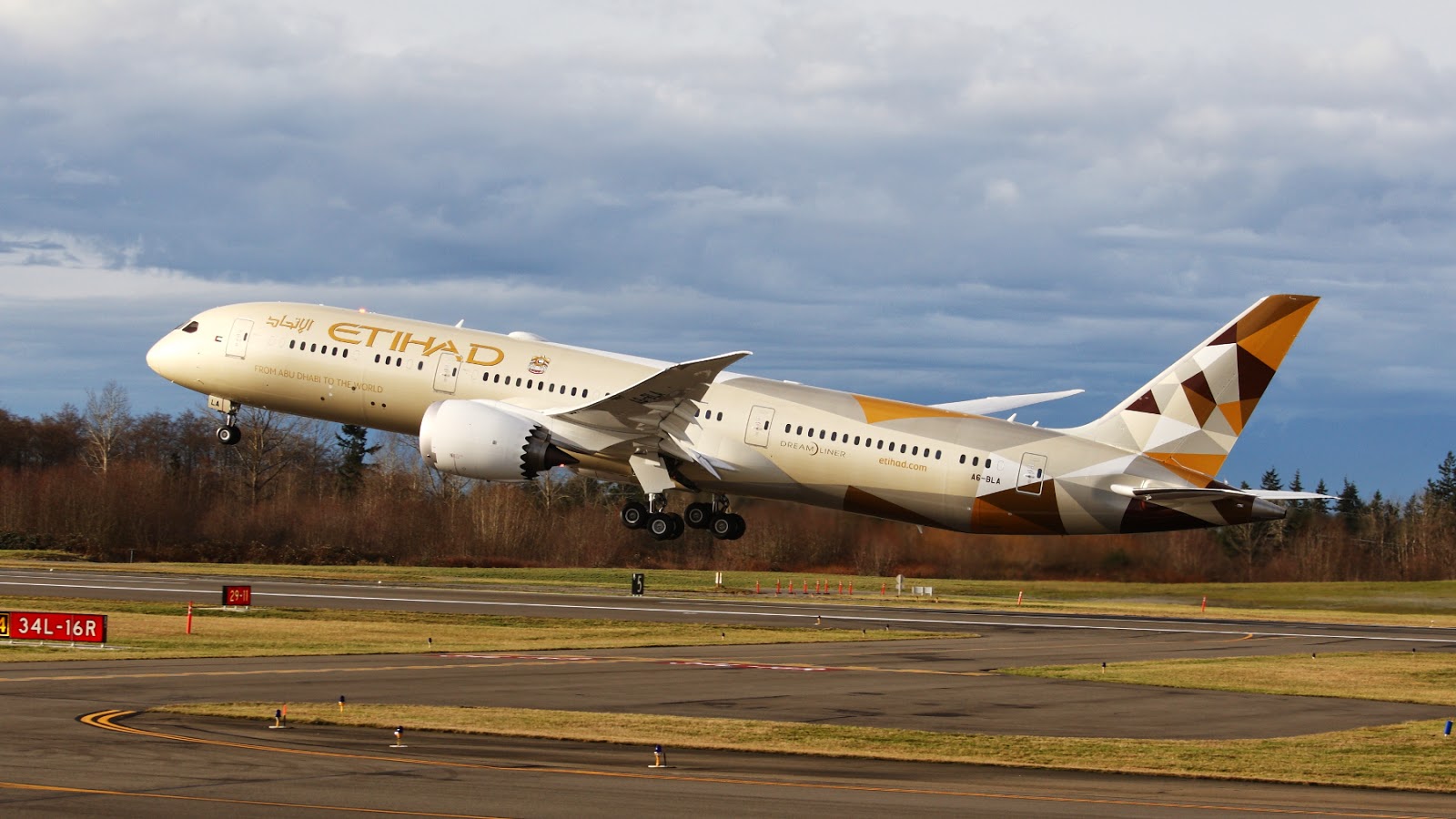

However, this is the first of many flights as Etihad starts an aggressive expansion in North America. The airline would start 3 new destinations in the United States within a span of 8 months backed by a strong demand from India which is being fed into Abu Dhabi by its equity partner Jet Airways.

Traditionally network carriers – which work on a hub and spoke model, schedule flights to a region at a particular time. Example – all flights from Europe to India would typically leave around mid-day to reach at night in India and depart so as to reach early morning in Europe. Departures to USA would be at similar time to ensure connectivity from east to west. This departure of flights is known as a bank of departures.

Cost of opportunity
As they say, cost of opportunity cannot be ascertained and when Etihad decided to go ahead and buy a 24% stake in Jet Airways and purchase the Jet Privilege Frequent Flier Program, it also came with an exponential increase in seat allotment from India to Abu Dhabi allowing new frequencies and destinations. While most of the tier II connections will be flown by Jet Airways, the major metro would see expansion from Etihad too.

Etihad Airways had clearly maintained the importance of a strong feed from India and how dipping deep into the Indian market was to play a pivotal role in their planned growth.  With the launch of their flights to Abu Dhabi from Chennai and Kochi, continuing on to Dammam and Kuwait, in the 2nd week of January, Jet-Etihad had given a very clear indication of the hub in Abu Dhabi they were working towards, which was re-enforced by the addition of the Hyderabad and Bengaluru to Abu Dhabi flights from 1st of March.

The hub was structured around the 2nd daily to New-York JFK, operated by a Jet Airways B777 aircraft, leaving Abu Dhabi at 0145 hours Local Time (LT), and returning at 0920 LT the next day, thus adding another bank of departures to the United States, later in 2014 EY added late afternoon departures to 6 India destinations, returning back to AUH by midnight, thus providing an Etihad operated connection to the JFK, newly launched SFO and other European flights.

Jet Airways was supposed to operate this flight but for the downgrade in status of Indian aviation by Federal Aviation Authority (FAA) which now bars any airline in India to add flights to United States. Etihad went on to add flights to Dallas Fort-Worth and Los Angeles using the 77Ls they had acquired from Air India. 

USA OVERHAUL
Coinciding with the enhanced availability of the US Preclearance, 9W-EY announced a major overhaul of schedules to their India - AUH - North American flight structure, w.e.f  29th March 2015. While in actual addition were just 21 weekly flights from Ahmedabad, Mangalore and Pune, along with additional wide body services from Etihad, there was a major shift in timings of Etihad's North-American Departures.

While Emirates has a mixed departure bank to USA, Etihad is trying to get maximum early morning arrivals into USA and could see further time changes in the next season as the India feed stabilizes.
  • To Toronto and Chicago from Abu Dhabi – which now leave late night from Abu Dhabi reaching early morning at destination.
  • Delaying the departure from New York to popular late afternoon 1530 hours, along with re-timing San Francisco departure so ensure that the arrival bank is stronger than ever.

Etihad now has two very prominent USA departure / arrival banks
  • Red eye departures to New York, San Francisco, Toronto, Chicago; returning back between 1200 – 1300 hours LT.
  • Mid-morning departures to Los Angeles, New York, Dallas; returning back during late evening hours.

This is far cry from Emirates bank to New York, Seattle, Houston, Boston, Los Angeles and San Francisco – which leaves mid-morning and returns late evening and flights to Dallas and Washington along with the second frequency to New York which leaves post-midnight returning in the afternoon.

Qatar Airways flies to seven destinations in the United States – all in one bank of mid-morning departures, barring Philadelphia which departs post mid night and does not connect to any Indian destination within an acceptable connection time. With just one bank of flights to India, the options are limited but connections are perfect.

Etihad would look at two banks of arrivals at Abu Dhabi from India
  • First between 2200 and 0100 which sees arrival from ten destinations and another between 0600 and 0800 from another 10 destinations
  • A mini Jet Airways hub at Abu Dhabi with flights from Hyderabad and Chennai going onwards to Dammam and Kuwait City.
  • One Mega departure bank between 2100 and 2300 with departures to 13 destinations
  • Connection from a total of 23 cities in India to Abu Dhabi and many more in second phase

Combined 9W-EY India Operations
Etihad with equity partner Jet Airways would operate 217 weekly flights to India effective 29th March 2015 as compared to 95 of Qatar and 188 of Emirates. While Emirates operates all wide body aircraft, Etihad – Jet Airways would operate the narrow body B737s for all of their flights to Tier-II cities.
Image Source: gcmap.com


ANALYSIS
With the new timings and addition of another bank of departure, Etihad – Jet Airways combine would connect Indian cities to New York, Chicago, San Francisco, Toronto, Dallas, Los Angeles, Washington in a seamless sub 3 hour connection, which is most preferred with travelers.

What would add up to this is the pre-clearance facility at Abu Dhabi which means that you land in USA as a domestic passenger having done your immigration during transit at Abu Dhabi.

Cities like Mangalore, Goa, Lucknow and Pune which see limited competition have longish connection times for few cities. Passengers from these cities tend to look for flying out of their own city rather than change flights at one of the hubs in India and then again in Middle east or Europe.

With fast expanding network of Etihad not just to United States but also to Europe and Etihad investing in Alitalia and Etihad Regional in Europe – passengers from tier – II cities in India are an attractive lot who can now transit at Abu Dhabi and reach their destination one stop.
While this change means a lot for feeder traffic, it also has positive implications for traffic originating in United States with New York, San Francisco and Chicago getting early morning arrivals. The differentiator here would be pre-clearance, however this will continue to be a tough market for Etihad with Emirates mounting flight after flight and upgrading flights to A380.

This change gives a big boost to Jet Airways aircraft utilization – from parking the planes overnight at Abu Dhabi, they will not have a full rotation. The existing utilization which has already crosses 11.7 hours, could well cross 12 hours post this change.
The bonding between Jet Airways & Etihad will only increase from here on as the inter dependency increases, with the entire bank to Unites states dependent primarily on feed from India for Etihad and the Abu Dhabi shuttles of Jet Airways dependent on Etihad to be filled up.

A little over a year after the deal went through 15 of 23 destinations are already connected to Abu Dhabi. As people say, India - USA market is so dynamic and diverse, that an airline doesn't have to target growth, it has to merely position itself in the most comfortable way to get the best out of it. So, as Emirates darts A380s to the US with an tremendous network feed, QR fully integrates itself into the One World structure,  Air India with incredible India penetration this is the path Etihad has chosen to grow on this sector.

Hard Product
The San Francisco and (2nd daily) New York flights are operated by Jet Airways configured 77Ws, consistency of hard product becomes a problem, business travelers and frequent flyers have always shown an inclination towards familiarity, and while the Jet Airways’ 77Ws have a fairly good hard product, the 737s, can't match up to EY's A320s, all of which on the whole creates a negative impact on frequent fliers. Even though, Etihad and partners are moving towards a single hard product, it is still some distance away as of now. 

Tail Note
Etihad would find it easy to fill up flights from Tier – II destinations to Abu Dhabi and onwards to Europe and USA as compared to Mumbai or Delhi. The two leading metros have direct connectivity to USA with Air India and United. With Abu Dhabi – USA being a 15 hour non stop flight, the comparable flight from Mumbai or Delhi drops you in Newark or Chicago. The odds of flying these are more if the final destination is not on the network map of Etihad. Etihad will have to grow rapidly in the United States in the next one year.

The airline has been struggling to get hold of the Indian market, even when it is growing leaps and bounds. The next focus, we believe would be on improving the hard product, standardizing it and focusing on marketing and sales efforts. 

There would be more in store from the partnership when India is upgraded to Category – I status by FAA, when the airline may launch a India – Abu Dhabi – Chicago by its own B777s either from Mumbai or Delhi and take a decision on its limited operational hub at Brussels.
  

Tuesday, February 24, 2015

Leading the pack yet again - IndiGo now corners 36.4% market share

Summarizing 2014
2014 was a year of mixed emotions for Indian Aviation. The industry returned to growth after a brief hiatus post the fall of Kingfisher Airlines and in the latter half of the year saw reduction in prices of Aviation Turbine Fuel (ATF) on global cues.

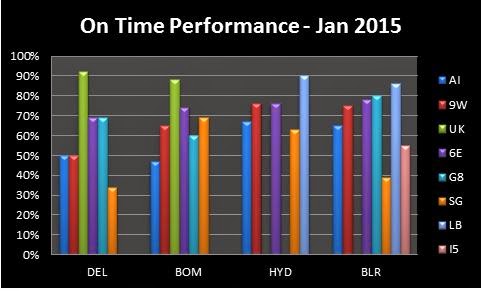
With this came the unprecedented but widely forecasted crisis at Spicejet, after few steady months. The year which started on a good note for Spicejet, having performed better than IndiGo in its much touted On Time Performance (OTP) ended with one of the worst performances on the same parameter for the airline, recording a low of 47% on time departures at Delhi in December’14.

Go Air, launched a new station – Bhubaneshwar and deferred delivery of its 20th aircraft, Air Asia had muted performance with expansion nowhere close to what was being discussed and published.

Jet Airways was resurgent with funding from Abu Dhabi’s Etihad and subsequent changes, while only other Full Service carrier Air India had its own share of problems with the technical glitches on the Dreamliner’s and engineering issues on the Narrow bodies yet made it to Star Alliance.

Well, that leaves us with IndiGo – which continued to expand with more flights between metros and launching flights to few more domestic and international destinations. The airline also, for the first time decided to induct aircraft available in open market as a stop gap arrangement till the A320 NEO are inducted.

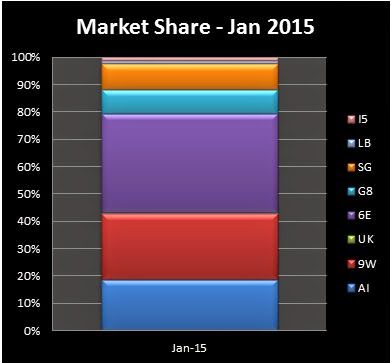
IndiGo continued to be a market leader, closing the year with a market share of 31.8% followed by Jet Airways and its subsidiary Jetlite at 21.7%. National carrier Air India garnered 18.4% while Spicejet cornered 17.4%. Go Air failed to breach the double digit mark and ended the year at 9.2% with Air Costa and Air Asia closing at insignificant 0.9% and 0.5% respectively.

2015 begins
Passengers grew 21.33% MoM in January 2015, an indication of return of good times and assertion that growth in capacity is followed by growth in passenger numbers.

The year started with news of change in ownership at Spicejet and launch of Vistara. Both will have an impact on the market in these 12 months of 2015. However, at the end of January, Spicejet was still struggling to get its act in order with an On Time Performance (OTP) of just 34% at Delhi in January. Indeed most of it was affected by fog, but it wasn’t fog alone which led to this performance.

The OTP remained an issue for all airports across the country due to the fog in North & East India which was around for a prolonged period than yesteryears. Normally unaffected stations also saw fog this year which compounded the problem.

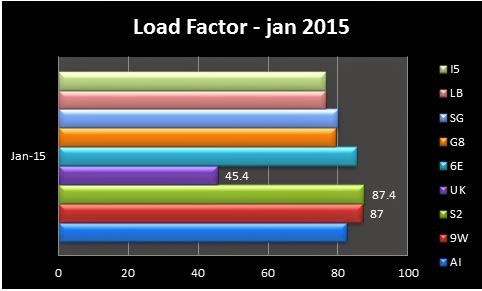
January 2015 saw a total of 62.45 lakh passengers taking to the skies, with the month clocking marginally lower Load Factors than December 2014.

Jet Airways clocked the maximum load factors of 87.4 percent for flights operated under Jetlite code (S2) and 87 percent for those operated under Jet Airways (9W), while the lowest load factors were clocked by new comer Vistara which recorded 45.4 percent. Vistara did not have complete month of operations and this was its first month, thus this is too early to judge the performance.

Spicejet saw maximum cancellations and also maximum complaints – a trend that should reverse very soon as funding is tied up and operations are back to normal.

IndiGo continued to outperform competition in market share as well as On Time Performance with overall On Time Performance of 73.3% and a market share of 36.4%. Spicejet had the worst On Time Performance with less than 50% of its flights being on time. This is largely due to its performance at Delhi being hit to a low of 34%.


Go Air has seen its market share slip from over 10% which it achieved twice last year to less than 9% now. With no addition to capacity, the airline will find it tough to hold on to the market share. However, the airline continues to have some monopoly or duopoly routes which the competition is not after. This is either due to slot constraints at Mumbai or the leaders fighting it out with the newbies in the market.


Challenges Ahead
2015 will be a challenging year, Vistara would be flush with funds to expand and Air Asia would be hoping to get back on track with newer routes, planes and a massive expansion if they have to sustain. So far it looks like IndiGo has been able to contain them and made them re-think on the plans they had. Jet Airways will continue its expansion to its middle eastern hub of Abu Dhabi with flights from Ahmedabad and Pune on agenda effective March. This year will also give us an answer on the European hub strategy of Jet Airways.  Spicejet will get its strategy in place with respect to Q400 and B737 and will have another “NEW” network this year.

If all goes well, by year end IndiGo may receive the all new A320 NEO. Spicejet would hope to stabilize the network and operations in first half of the year and take a decision on the Q400s by mid-year. Go Air could well be the next airline to start international operations, most likely a short hop from Mumbai or Delhi.

Lastly, the government will have to get its house in order and iron out differences on the revised Route Dispersal Guidelines and revise the 5/20 rule at the earliest. The battle for Noida airport will increase from here on and so would this be a critical year for Navi Mumbai. Any delay now, will mean the airport opening certainly gets pushed post next general elections

I can only hope for a great 2015 for Indian Aviation !


Friday, December 5, 2014

Air Canada returns to New Delhi effective November’15

In an unexpected announcement, Air Canada (IATA code AC) announced resumption of services to New Delhi (IATA code: DEL) beginning November’15. (Winter Schedule-2015). The flights will be operated by B787 Dreamliner aircraft, and the press release claims this will be the first route with the longer range B787-9, which will operate on two of three weekly services proposed by the airline.

The airline will operate this non-stop service four times a week,
Flight
From
To
Depart
Arrive
Days of the week
AC050
Toronto
Delhi
20:55
21:15 (+ 1 day)
Monday*, Wednesday, Friday, Sunday
AC051
Delhi
Toronto
00:45
05:00
Tuesday, Wednesday*,Thursday, Sunday
Departure from Toronto on Monday & from Delhi on Wednesday will be operated by B787-800.

Historic and current links to Canada
While Air India operated Amritsar – Delhi – Toronto flight, the same was pulled out owning to heavy losses in May’12. Air Canada also,in the past operated flights on the Toronto – Delhi sector. Both the airlines had flown this route with the B777 variants and Air Canada will benefit from the favorable economics of the B787 over the B777.

Currently only Jet Airways operates a flight to Toronto, via its hub at Brussels from Delhi, with connections from Mumbai.  With talks of Jet Airways shifting its hub from Brussels to Amsterdam or to Abu Dhabi, the future of flights to Toronto would be in question.

B787 – Dreamliner
The aircraft has its share of problems across the globe, including with Indian national carrier Air India. While Air India has two class configurations, Air Canada has configured its Dreamliner’s (B787-800 variant) in three class configurations with 20 Business, 21 Premium Economy and 210 Economy class seats. The Star Alliance member is yet to reveal the configurations of its longer B787-900 variant.  

While the B787-900 will have wingspan and fuselage same as those of the -800 variant, it is expected to be longer by 6 meters and higher Maximum Take Off Weight (MTOW), with a range of 15372km, compared to 14500km of the smaller B787-800 variant.

Delhi Hub & Connectivity
Not long ago, Star Alliance had made intentions clear about having a hub at Delhi along with Mumbai. Clearly the entry of Air India in Star Alliance is helping Delhi develop itself as a hub, along with attracting global traffic.

As per existing schedules of Air India, the inbound flight would connect to multiple destinations
Inbound
Connection Time
Destination
1 - 3 hours
Mumbai(AI), HongKong(AI), Bangkok(TG)
3 - 6 hours

6 - 9 hours
Ahmedabad(AI), Lucknow(AI), Pune(AI)
9+ hours
Khatmandu(AI), Hyderabad(AI), Chennai(AI), Kolkata(AI), Kochi(AI)

Outbound
Connection Time
Destination
1 - 3 hours
Chennai(AI), Mumbai(AI), Ahmedabad(AI), Kochi(AI), Kolkata(AI), Bangkok(TG)
3 - 6 hours
Singapore(SQ), Pune(AI), Hongkong(AI), Lucknow(AI)
6 - 9 hours

9+ hours


Re-timings would help Air Canada connect both ways to Singapore on Singapore Airlines, while it would already connect to Bangkok on Thai Airways – both Star Alliance members.

Concerns
While this new link is a welcome move, the traffic between Canada & India has remained stagnant for a while. The traffic patterns are mainly seasonal and there are ample options available via Europe, Middle East & the USA.


Resistance of Canadian government to grant more rights to Middle Eastern carriers and requirement of US visa for transit would benefit this non-stop service of Air Canada. 

Friday, October 17, 2014

Aviation Weekly

The WS14 schedule comes in effect from 26th October’14, airlines in India and world over are busy making schedule changes. Across the world, leading airlines make changes in the schedule well in advance to ensure that bookings are open for right flights.

However, the story changes completely in India. An airline like Jet Airways which has a large & extensive network, simply replicates the schedule of last winter to this winter and same for summer. People tend to see a lot of flights, which the airline has not flown and will not fly, open in the reservation system. The same would get cancelled few weeks before the start of schedule and inconvenience the passengers.

This also has financial impact, since every GDS change is charged to the airline, and hence large number of transactions has a drag on the company finances.

This winter schedule will see Jet Airways shifting focus to Abu Dhabi, launching flights from more cities in India to Abu Dhabi along with further changes on the domestic network, IndiGo trying to expand and prevent Air Asia from expanding, Spicejet trying to consolidate and stabilize with reduction in capacity and Go Air launching a new station with the existing fleet.

GoAir launches Bhubaneshwar

Go Air is launching flights to Bhubaneshwar, effective winter schedule. The flights would connect Bhubaneshwar to Kolkata, Mumbai & Delhi. The flights would operate as below.
G8161 DEL0610 – 0815BBI D
G8162 BBI0845 – 1110DEL D
G8163 DEL1645 – 1855BBI D
G8164 BBI1925 – 2130DEL D

G8243 CCU0920 – 1030BBI D
G8244 BBI1830 – 1940CCU D

G8243 BBI1100 – 1335BOM D
G8244 BOM1540 – 1755BBI D

This will be 22nd station for Go Air and a new station after 2012, when Chennai & Port Blair were launched. Go Air has launched this without any addition to its fleet and operates 19 aircraft across its network.

IndiGo is the dominant player at Bhubaneshwar with flights to Delhi, Kolkata, Bengaluru, Vizag, Mumbai, Chennai & Hyderabad. Go Air is attempting to fill in the void created by Jet Airways when it pulled out of Bhubaneshwar as part of network restructuring. Jet Airways was a dominant carrier once upon a time with double daily flights to Kolkata and direct flights to Bengaluru, Mumbai, Delhi, Raipur and Chennai.

IndiGo expands, again!

IndiGo, recently in news for placing a 250 aircraft A320 NEO order, and a deal with Tiger airways is adding capacity on domestic sector.

Effective winter schedule, it is adding flights on Bengaluru – Delhi and Delhi – Goa sector. This will be 9th Daily flight on Bengaluru – Delhi and 4th Daily on Delhi – Goa.

6E399 DEL1150 – 1450GOI D
6E398 GOI1445 – 1720DEL D

6E507 DEL1840 – 2050BLR D
6E508 BLR0820 – 1050DEL D

Considering the long gap at Bengaluru, from 2050 till 0820, an international leg in future may not be ruled out. The international leg could be to one of its existing stations, with Dubai being the most likely and the alternative being Singapore.

IndiGo adding second daily to Coimbatore

IndiGo will add one rotation from 17th November from Delhi, which will operate Delhi – Coimbatore – Chennai – Kolkata and vice versa. This will be 2nd Daily non-stop service on the Delhi – Coimbatore sector, 3rd Daily on Chennai – Coimbatore and 5th Daily on Chennai – Kolkata sector.

IndiGo has monopoly on the non-stop Delhi – Coimbatore sector, whereas it would have maximum seats & frequency on Kolkata – Chennai sector, where Air India and Spicejet operate one and three daily flights respectively

The new flights would operate as below.

6E397 DEL0640 – 0925CJB D
6E272 CJB1000 – 1055MAA D
6E272 MAA1140 – 1345CCU D
6E275 CCU1415 – 1645MAA D
6E275 MAA1715 – 1820CJB D
6E396 CJB1850 – 2200DEL D

This rotation will start after delivery of its 100th aircraft on order and last of the initial order placed in 2005. The aircraft is likely to be registered as VT-IAY.

Jet Airways, operated the Coimbatore – Chennai – Kolkata leg as part of its Ahmedabad – Bengaluru – Coimbatore – Chennai – Kolkata rotation but pulled out after operating for two seasons.

This is a classic case of how a lean airline with low cost base can sustain, survive and grow as compared to one with financial liability. Only IndiGo has survived on the Ahmedabad – Bengaluru sector, which has been tried and shut by other airlines like Jet Airways, Go Air and Spicejet.

Air India takes delivery of another Dreamliner, upgrades flights to Bangkok

Air India recently took delivery of its 17th B787 Dreamliner aircraft, registered VT-ANR.
Air India which operated Mumbai – Bangkok – Mumbai and Delhi – Bangkok – Delhi flights on A321, is upgraded these sectors to B787 Dreamliner, effective 14th October.

The timings are as below
AI330 BOM0200 – 0745BKK D
AI333 BKK0855 – 1200DEL D
AI332 DEL1340 – 1935BKK D
AI331 BKK2050 – 2340BOM D

These new flights give another swapping opportunity and better rotate the B787 in Air India’s fleet.

The domestic segment of this flight, AI330 Goa – Mumbai, continues to be operated at existing timings with A321.

This comes after Air India started flying direct on the Mumbai – Singapore sector, changing its earlier rotation of Mumbai – Chennai – Singapore – Chennai – Mumbai. The new rotation, Mumbai – Singapore – Chennai – Singapore – Mumbai, gives it an edge over relatively lucrative Mumbai – Singapore sector but has to compete with Singapore Airlines A380 flights at similar timings along with Jet Airways which operates double daily flights onboard the B737.

Chennai – Singapore sector is considered one of the lowest in terms of RASK and thus timings may not make a big impact either ways

Air India re-introduces flights to Vadodara

With the Minister of Finance of Gujarat Government going public and requesting Air India to re-start flights to Vadodara, Air India seems to have taken note and restarted flights. Earlier the flight was operated by CRJ-700 and now this would be operated by A320
The flight would operate as below,

AI819 DEL0625 – 0800BDQ D A320
AI820 BDQ0835 – 1015DEL D A320

The flights will be operated by all economy A320

Spicejet cancels select flights

SpiceJet, the only operator on Mumbai – Surat sector has withdrawn flights till further notice. The announcement was done on Twitter. The airline started Surat with operations from Delhi and Mumbai and last season changed to have separate flights to operate Kolkata – Bengaluru – Mumbai – Surat and vice versa, and Delhi – Surat – Delhi with one way connection to Kolkata.

The Bengaluru – Mumbai – Bengaluru leg of the flight is not available for booking till the beginning of Winter Schedule.

Spicejet re-delivers another aircraft


Spicejet has re-delivered another aircraft, VT-SPT, which was named Clove. The aircraft was ferried to Dublin, Ireland via Ankara, Turkey. VT-SPT was B737-900ER and with Spicejet for close to 7 years. The number of B737-900 in fleet is down to 5.