Showing posts with label Spicejet. Show all posts

Tuesday, February 24, 2015

Leading the pack yet again - IndiGo now corners 36.4% market share

Summarizing 2014
2014 was a year of mixed emotions for Indian Aviation. The industry returned to growth after a brief hiatus post the fall of Kingfisher Airlines and in the latter half of the year saw reduction in prices of Aviation Turbine Fuel (ATF) on global cues.

With this came the unprecedented but widely forecasted crisis at Spicejet, after few steady months. The year which started on a good note for Spicejet, having performed better than IndiGo in its much touted On Time Performance (OTP) ended with one of the worst performances on the same parameter for the airline, recording a low of 47% on time departures at Delhi in December’14.

Go Air, launched a new station – Bhubaneshwar and deferred delivery of its 20th aircraft, Air Asia had muted performance with expansion nowhere close to what was being discussed and published.

Jet Airways was resurgent with funding from Abu Dhabi’s Etihad and subsequent changes, while only other Full Service carrier Air India had its own share of problems with the technical glitches on the Dreamliner’s and engineering issues on the Narrow bodies yet made it to Star Alliance.

Well, that leaves us with IndiGo – which continued to expand with more flights between metros and launching flights to few more domestic and international destinations. The airline also, for the first time decided to induct aircraft available in open market as a stop gap arrangement till the A320 NEO are inducted.

IndiGo continued to be a market leader, closing the year with a market share of 31.8% followed by Jet Airways and its subsidiary Jetlite at 21.7%. National carrier Air India garnered 18.4% while Spicejet cornered 17.4%. Go Air failed to breach the double digit mark and ended the year at 9.2% with Air Costa and Air Asia closing at insignificant 0.9% and 0.5% respectively.

2015 begins
Passengers grew 21.33% MoM in January 2015, an indication of return of good times and assertion that growth in capacity is followed by growth in passenger numbers.
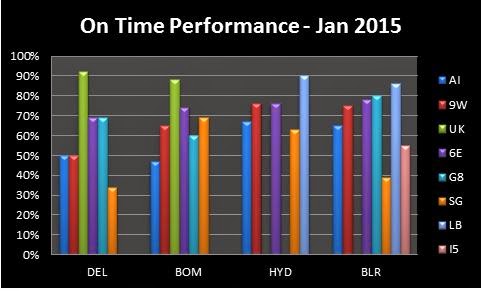
The year started with news of change in ownership at Spicejet and launch of Vistara. Both will have an impact on the market in these 12 months of 2015. However, at the end of January, Spicejet was still struggling to get its act in order with an On Time Performance (OTP) of just 34% at Delhi in January. Indeed most of it was affected by fog, but it wasn’t fog alone which led to this performance.
The OTP remained an issue for all airports across the country due to the fog in North & East India which was around for a prolonged period than yesteryears. Normally unaffected stations also saw fog this year which compounded the problem.
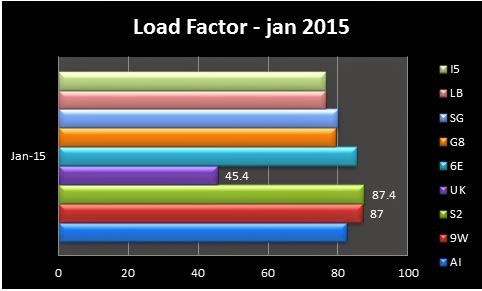
January 2015 saw a total of 62.45 lakh passengers taking to the skies, with the month clocking marginally lower Load Factors than December 2014.

Jet Airways clocked the maximum load factors of 87.4 percent for flights operated under Jetlite code (S2) and 87 percent for those operated under Jet Airways (9W), while the lowest load factors were clocked by new comer Vistara which recorded 45.4 percent. Vistara did not have complete month of operations and this was its first month, thus this is too early to judge the performance.

Spicejet saw maximum cancellations and also maximum complaints – a trend that should reverse very soon as funding is tied up and operations are back to normal.

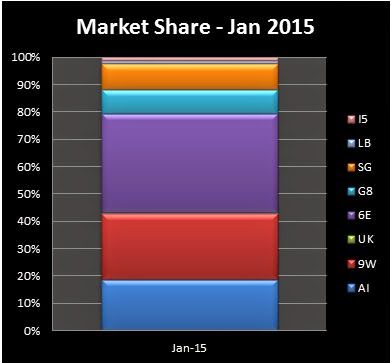
IndiGo continued to outperform competition in market share as well as On Time Performance with overall On Time Performance of 73.3% and a market share of 36.4%. Spicejet had the worst On Time Performance with less than 50% of its flights being on time. This is largely due to its performance at Delhi being hit to a low of 34%.


Go Air has seen its market share slip from over 10% which it achieved twice last year to less than 9% now. With no addition to capacity, the airline will find it tough to hold on to the market share. However, the airline continues to have some monopoly or duopoly routes which the competition is not after. This is either due to slot constraints at Mumbai or the leaders fighting it out with the newbies in the market.


Challenges Ahead
2015 will be a challenging year, Vistara would be flush with funds to expand and Air Asia would be hoping to get back on track with newer routes, planes and a massive expansion if they have to sustain. So far it looks like IndiGo has been able to contain them and made them re-think on the plans they had. Jet Airways will continue its expansion to its middle eastern hub of Abu Dhabi with flights from Ahmedabad and Pune on agenda effective March. This year will also give us an answer on the European hub strategy of Jet Airways.  Spicejet will get its strategy in place with respect to Q400 and B737 and will have another “NEW” network this year.

If all goes well, by year end IndiGo may receive the all new A320 NEO. Spicejet would hope to stabilize the network and operations in first half of the year and take a decision on the Q400s by mid-year. Go Air could well be the next airline to start international operations, most likely a short hop from Mumbai or Delhi.

Lastly, the government will have to get its house in order and iron out differences on the revised Route Dispersal Guidelines and revise the 5/20 rule at the earliest. The battle for Noida airport will increase from here on and so would this be a critical year for Navi Mumbai. Any delay now, will mean the airport opening certainly gets pushed post next general elections

I can only hope for a great 2015 for Indian Aviation !


Saturday, February 7, 2015

Baby Steps to 2017 - Jet Airways declares profit after seven quarters

This article has been jointly written by Prathamesh Kini & Ameya Joshi

Aviation industry in India is noticed more for wrong reasons than for the good reasons and thus Spicejet made most of the news in the last quarter. What the industry missed out on was the constant growth in share price of Jet Airways – in a quarter traditionally considered good for the industry and in the case of Jet Airways – the one in which it shifted to a full service model.

Net profit was a foregone conclusion since the airline had already announced that amount received by the sale of Jet Privilege – the frequent flier program, will be shown in tranches. The eyes were thus set on operating profit.

As late last evening Jet Airways announced results, it indeed report a wafer thin operating profit, its first after seven consecutive quarters of losses. Improvements came all across, however there continued to be some areas of concerns.

The airline reported an overall profit of INR 63 Cr for the third quarter of FY14-15. For the past 9 months, the airline now stands at a loss of INR 84 Cr with very slim chances of closing the year on a profitable note. The airline continued to post proceeds from the sale of Jet Privilege Frequent Flier Program to Etihad as part of its balance sheet this quarter.

The results of Q3 have a lot of positives, with the foremost being an impressive 11.5% increase in Total revenues taking it to INR 5051 Cr on a Y-o-Y basis. The operations are now sustainable on the back of this climb in revenues and lower cost due to decrease in fuel cost (11% reduction in expenditure Y-o-Y). Total Expenses have increased by 5.4% to Rs. 5014.5 Cr. y-o-y, aided primarily by drop in fuel costs and a stable currency exchange. Going forward, these costs will stabilize based on outlook for global oil prices and Indian economy. However the conversion to full service model, advertising its umpteen runs to Abu Dhabi from across the country and fleet conversion has come at a cost – which has led to an increase of expenditure by 42.8% Y-o-Y to INR 502.1 Cr.

Its time to cheer for specialists looking to make a career in Aviation, as the airline saw addition of manpower, taking the headcount to 12,897 employees an addition of 9.3%. It is good to see an operating profit of INR 36.6 Cr. (without income from Sale & Lease Back). When your core operations start making money, the signs are always bright for shareholders! This reminds of a Guy Finley quote 'Being fully present is the best guarantee for a bright future'.

While it was always believed that the investment by Etihad would be used to retire old high cost debt, the interest component paid up has reduced by just 1.6% to INR 226.4 Cr on absolute terms and this should be a concern in the longer run. However, most of this is offset by  operating profit and income from Sale & Lease Back which stands at INR 219.7 Cr. This situation should temporarily ease frayed nerves of the lenders. With a positive outlook on economy for the next few quarters, the airline looks on track to achieve an operating profit in 2017 as it has aimed for. This will come at the back of fixed or decreasing interest dates since income from Sale & Lease back will not continue for long.

Without exceptional items, the company has posted a loss of Rs. 6.7 Cr. which seems a lot more positive as compared to losses of Rs. 235.2 Cr. in Q2FY15 and Rs. 289.0 Cr. in Q3FY14. The overall rejig and stability at Jet Airways has been cheerful for the shareholders too, with Earning Per Share of INR -9.4 for the three quarters of FY15 as compared to INR -167.3 in the corresponding period last year.

Passenger growth has been phenomenal at 13.8% led by fare sales but growth in revenue has been 10.6% with RASK growing 1.7% Y-o-Y. The combined effect has led to a drop in average gross revenue per passenger by 2% to INR 8504.

While the company has managed to achieve break-even load factors (including exceptional items), in the long run we believe that the company should release break-even load factors without exceptional items, since they will not be a permanent feature on the P&L.

Jetlite operations
The operations continue to be a drag on the balance sheet. While operations are being reduced progressively that had led to a reduction of 17.5% departures yet an improvement in load factor to 82.7%, the break-even load factor continues to be very high at 97.3%. The average revenue per passenger is a meagre INR 4433, almost half of that of the parent.

The reason for the lower average revenue is also due to the sectors on which Jetlite aircraft are operating at the moment. Slowly but surely, the sub brand will be phased out and if that is going to take time, the aircraft would be repainted to remove brand confusion.

Points to Smile
  • Profits are profits and even a marginal one is a good beginning
  • 10.4% increase in passengers carried
  • Seat factor up by 5.2% to 82.1% almost equal to break-even load factor
  • Exponential increase in code share traffic

Points to ponder
  • Overall FY14-15 will be a loss when Q4 results are declared
  • Q4 is considered weak and a resurgent Spicejet will initiate a lot of sale and offers
  • Vistara is expanding on key Mumbai – Delhi route
  • Q4 will be first full quarter with Full Service Model 

Way Forward
The airline is now focusing on domestic as well as international operations. Reduction in services by Spicejet would have helped grow yields since the network overlaps at multiple stations. The shift to Full service will also distinguish itself from market leader IndiGo – which continues to grow rapidly. Vistara will take time to catch up country wide and the dual fleet strategy of Jet Airways will continue to feed its network at major metro’s.

The airline intends to return to absolute profitability till 2017 and we believe that the balance sheet will continue to be black till then, either by showing the money received on account of the strategic sale of Jet Privilege or later on Sale & Lease Back transactions.


The airline could now place an order for a mix of B737MAX and ATR72-600. Standardization is a major problem which the airline needs to come up with sooner or later. With the SAARC and Middle East flights on Narrowbody – the customer experience is paramount when competing with modern widebodies from competitors.  


Analysis of the results of last quarter can be found here

Wednesday, February 4, 2015

Fiasco at induction - what went wrong when the Q400s landed ?

A lot is being written and discussed about Spicejet and its strategy for dual fleet. While a parallel is being drawn with successful western carriers to push forward the argument of a single fleet, the successful western carriers – RyanAir, EasyJet or Southwest operate in an environment which has umpteen airports with supporting infrastructure for the B737 or A320 family unlike India where there would only be a handful of airports and most of which have some or the other constraint.

Personally, I believe the differentiator for Spicejet always was to have a dual fleet and move from a pure play LCC to a value based LCC which will help passengers reach airports which are not covered by market leader IndiGo and is cheaper than Full Service carrier Jet Airways.
The question that needs to be asked is – Was Q400 right for Indian conditions or the proven ATR72 would have been a better bet? Going by the teething troubles for the Q400 and the engineering issues which the airline is believed to have faced – yes the proven ATR72 would have been better.

If the promise to do one more flight a day than the ATR72 cannot be met because the operator needs a break in schedule in the middle of the day for engineering reasons, the spending on Q400 is not justified.

Today I am going to take a look at what went wrong at the time of induction of the Q400s and how the legacy cost which the current management has to handle is in addition to the legacy deals and aircraft like the Q400.

This only highlights how important fleet selection is, in addition to planning the network and pricing your tickets.

What exactly went wrong with the Q400?
A realization had dawned upon Spicejet after the first set of aircraft were to arrive in India that at all places where ATR-72s operate, a Q400 may not operate? And why is that so?
In April 2012, I had written a piece on the induction of Q400s by Spicejet on this blog.

What had I not mentioned in this article was the lack of planning while inducting the Q400s. When the schedule was initially filed, regulatory authorities rejected the filing for quite a few airports and expressed inability to support the Q400 operations.

The answer lay in the Airport Rescue and Fire Fighting Services (ARFF) category. At a length of 32.84m and a fuselage diameter of 2.89m, Q400 required Category VI firefighting equipment at airport as compared to category V of ATR 72 with a length of 27.2m and 2.57m fuselage diameter.

The difference is huge, since Category I – V required one vehicle for ARFF and Category VI & VII require 2 vehicles. This meant that while Q400 could operate to airports like Jaipur, Indore, Bhopal, Lucknow and many others which see regular narrow body operations, it could not operate to Dharamshala, Allahabad, Gorakhpur and many others which saw ATR 72 operations and were potential stations for the Q400. The story was same in the south, with Rajamundry, Vijaywada having similar problems.

So the Q400s started with operations to town and cities which saw narrow body operations by other carriers and the planned shock and awe of induction and expansion had to wait.
This certainly would have hit the revenues since typically the revenue on competitive routes is lesser at unit basis than those to monopoly or duopoly routes where the airline intended to fly. Besides, the whole marketing idea of taking on the ATR by a faster Q400 did not take place since the Q400 started competing with the B737s or A320s which are preferred by passengers over the turboprops.

Unfortunately, I have not had a chance to fly the Q400 ever and thus I will not comment on how the aircraft fares with the ATR from the user experience perspective but will only hope that the airline gets a good deal to continue using the Q400s and develop a unique model between the Full Service carriers and the market leader!


Saturday, November 15, 2014

Down but not out - Analyzing SpiceJet Q2

In September’12 the Indian Government, approved 49% FDI in Indian Airlines. Kingfisher was already in a holding pattern, trying desperately to get whatever help it can, after not having paid its employees for a considerable period of time, Jet Airways had a debt burden which kept mounting every quarter, IndiGo continued to report profits, and Go Air for once was expanding, consolidating and claiming profits. But a question to anybody in the industry or outside on who is better placed for getting investments – ended up with unanimous answer – SpiceJet. The airline had declared profits in Q1 (Apr-Jun 2012), exceptionally reduced losses in Q2 YoY (Jul-Sep 2012) and was expanding rapidly on domestic routes and launching international stations.

The Q400s had arrived and crisscrossed south and north of the country, Blue Skies policy on international route led to launching flights to places as far as Guangzhou – a first for Indian carrier, Kabul – Another first for a private Indian carrier, and between some unconnected city pairs – Ahmedabad – Muscat, Madurai – Colombo and so on.

Circa - 2014, and a lot of water has flown under the bridge for SpiceJet. It remains a mystery as to how and why Spicejet lost the plot and from being the most suited bride, is now struggling to find a match and as many believe, struggling to stay afloat.

A lot of parallels are being drawn with Kingfisher, but luckily salaries still are on time, International flights have not been pulled out after the initial network rejig, tax issue has been amicably solved, and the top management is ensuring that morale of the work force is high with constant presence on twitter, denying negative reports and introduction of new product and weekend uniforms. However, few aircraft are grounded and robbed for spares, At least 3 of 6 B737-900s returned to lessor and at least 4 B737-800s being returned to lessor in the past few weeks, with rumors of employees constantly looking out for opportunities.

The re-delivery of aircraft and grounding, along with the unfortunate “Buffalo” incident at Surat, the schedule and On Time Performance has gone for a toss, with regular delays across domestic network. The airline has skillfully managed to avoid negative publicity due to these delays and has ensured that international flights are not delayed.

The July – August, traditionally weak quarter, saw frequent sales by SpiceJet shoring up revenues, Load Factors and constant information by top management on RASK improvements across all platforms. While a common passenger may not even be aware about RASK, he or she is more than happy to have cheap tickets to travel and that has helped shore up Loads for the airline, which is giving it its much needed cash to meet operational expenditure if rumors are to be believed. The airline has not announced sale for a long time now.

The airline carried 32.83 Lakh passengers in Q2, which is a tad lower than much larger Jet Airways which carried 33.76 Lakh along with its subsidiary JetKonnect. With a market share of 19.6%, this was the best quarter in calendar year 2014.
The last Annual report talked about increased frequencies, improved OTP & Spare Capacity, none of which has been possible, due to grounding of aircraft and return to lessors. In fact, for the first time in its history, SpiceJet became the smallest carrier in Mumbai with least number of departures.

However the results do show some positive signs, but a lot needs to be done for the airline to survive and the recent spate of re-delivery, cancellations, rescheduling is not making it favorite with the passengers.

Issue of warrants to the promoter group should pump in some “much needed” equity into the firm after red flags by auditors over ‘going concern’ status in the previous quarters. The proceeds have been used to for working capital. Yet, currently the Liabilities outweigh the Assets by INR 1498.6 Cr. & it continues to be a concern.

On operational front, inspiring figures are forthcoming (as compared to previous Quarters) with capacity up 7.0%, RASK up 12.0% and CASK down 7.0%. The impact of fuel costs reduction wasn’t felt and exchange rate benefits were minimal and hence, these figures are notable. But Statistics can be deceiving and when all figures are given out in Percentage, one must have a cautious approach till you see the actual number. And yet again SpiceJet led by its top management has only made statements in percentage terms without giving out the actual numbers for either the RASK/CASK or ASKM, the parameters least understood by even the analyst community in India. No matter what percentage improvements and basis point improvements have taken place, the fact continues that the airline has reported losses in both the quarters this year.
One example, I keep giving to show the gravity of this is when Infosys says that their utilization of resources is 70%, which sounds good but when you translate that to absolute number, it means about 35,000 employees are on bench without work, which indeed is a vast workforce! 

Impressive growth in Other Income driven by ancillary revenues. Stands at Rs. 28.09 Cr. which represents a 70.4% growth Q-o-Q and 127.1% growth Y-o-Y. Hints at not only the success of avenues like SpiceMax suite, where the price conscious Indian is waking up to being charged for added benefits. Operating Revenues at INR 1425 Cr. clocked a growth of 16.4% Y-o-Y, which is extremely striking for a traditionally weak quarter. 

Going ahead, the return of aircraft to lessors, should help reduce Aircraft Lease Rentals and Aircraft Maintenance Costs, though might see a temporary increase in Aircraft Redelivery Expenses which have increased to INR 64.1 Cr. for H1 FY 15 as compared to INR 10.3 Cr. for H1 FY 14. However, this is likely to further reduce capacity and if schedule is not altered and reduced in line with capacity, unlike what is the case now, SpiceJet could be at receiving end from the passengers who are facing severe delays in many cases.

Reasons to Smile
Increase in Load Factor 
Drop in Fuel Prices

Some Worries
Re-delivery of aircraft leading to reduced capacity
Impact on On Time Performance and loss of high yielding business travellers
5 straight quarters of losses at a time when the airline needs funds desperately
Auditors concerns

Outlook for Q3
Historically, Q-o-Q operational revenue growth for Q3 over Q2 has varied from 30.0-50.0%. Considering a fair 25.0% growth in revenue in Q3 to around INR 1800 Cr. (Q3 FY 14 revenue at INR 1796.3 Cr.) should help in churning out an operational profit.

However, there will be a significant drop in capacity due to re-delivery of aircraft and thus the historic impact may not be seen this year.

SpiceJet should rest speculation on the fleet, and if there is a fleet plan in place, announce the same in public along with reduction in flights. Misinformation can be deadly, but No information can be deadlier and currently its heading into a phase of No information.


Conclusion
Will operating profits or huge equity investments come true before worries about going concern becomes troublesome? Only future will tell. 
"A bankruptcy judge can fix your balance sheet, but he cannot fix your company" - Gorden Bethune, ex-CEO Continental 


---------------------------------------------------------------------------------------------------------------------------------------------------
Co-Author : Prathamesh Kini

Tuesday, November 11, 2014

Draft Civil Aviation Policy - Another policy without substance


The draft Civil Aviation Policy was released by the Honorable Minister of Civil Aviation – Ashok Gajapathi Raju Pusapati yesterday. I had a lot of hopes from the policy since the last decade was plagued with policy paralysis in the Indian government. There is a stiff competition between which sectors suffered the most – Coal, Telecom, Industry or Aviation. The perceived scam in purchase of Air India aircraft, merger of Air India & Indian Airlines, lack of efforts to abolish the 5/20 rule( airlines require minimum 20 aircraft and 5 years of domestic operations to start flying international), non-classification of ATF (Aviation Turbine Fuel) into declared goods category attracting uniform 4% tax across the country, decision to go ahead with redevelopment of Chennai & Kolkata airports by AAI – leading to the disaster that they are today, as compared to world class facilities at Delhi, Mumbai, Hyderabad & Bengaluru, and many more. The list is unending.

However, prima facie the draft policy looks like listing of all problems that need to be resolved and have been in that state for a long time. The policy only highlights the problems without laying down the solutions or ways & means to tackle the problems. It promises to look after taxation issues on ATF, the 5/20 rule and route dispersal guidelines, but gives little on how and when this will be addressed.

There is a common saying – “The more things change, the more they remain the same”. Unfortunately I do not know who this saying is attributed to, but when you see the Strategic 5 year plan of the past government presented by the then MoCA (Minister of Civil Aviation) in 2010 and the Draft Civil aviation policy of this government, one tends to agree with the statement. Both start with quoting ICAO (International Civil Aviation Organization) statistics of generation of 610 indirect jobs for every 100 direct jobs in aviation.

The Strategic Plan 2010-2015 talks about Indian being recognized as a role model by FAA, which today has downgraded the safety rating to Category 2, Inclusion of 500 more aircraft in Indian skies and 300 more helicopters, One helipad every 100kms on highways, and many more, most of which continue to be Aspirational – similar to the section under which it is quoted in the Strategic Plan.

The new Draft policy talks about having airports as integrated multi-modal hubs with Rail / Road / Metro connectivity, access to manufacturing, business & tourism areas, up-gradation of 18 airports which amount to 86% of traffic, developing the 6 metro airports to have a hub & spoke model, Rationalization of ATF costs by having uniform taxes, Development of 6 metro airports as cargo hubs, Listing of AAI & Pawan Hans, changing the regional connectivity policy and reviewing the 5/20 rule, Air Navigation System & up-gradation of DGCA.

While these are welcome moves, the Revised Route Dispersal guidelines, which were formulated by a leading consulting firm are pending implementation for over two years, due to disagreement between carriers on the nature of the requirements. The airport at Bengaluru located about 40kms away from the city center recently got decent road connectivity. The rail connectivity envisioned while construction of airport is still elusive, many of the 35 non metro airports which saw modernization are already facing shortage of space (Eg: Jaipur) or are white elephants and AAI is incurring huge losses at these places (Eg: Aurangabad, Indore).

The Hub & Spoke model has been a success as Delhi – since there is no other airport in the vicinity which can attract so much traffic, but the same does not work well in the south, where Bengaluru, Chennai & Hyderabad compete fiercely with each other. So while SpiceJet based their Q400s in Hyderabad, a lot of the destinations are connected from Bengaluru and Air Asia changed plans and moved to Bengaluru from Chennai, yet there is no perfect Hub & Spoke at either of these places like there is at Delhi.

However, all has not been bad, implementation of GAGAN, changes in Air Navigation System and subsequent trials at Jaipur, up-gradation of ATC infrastructure at Mumbai and increase in runway capacity, are some of the silver linings.

One can only hope that the draft Civil Aviation policy gets into some tangible project plan, which is implemented phase wise with bounded timelines and the next 3-5 years, would see a serious change in the infrastructure & policy in Indian civil aviation. As more airlines take to skies, the pressure on infrastructure would be immense and similar to the boom in 2005-6 which most of us remember well and would hope is not repeated.


Friday, October 24, 2014

The Aviation Weekly

1. Air Asia changes flight timings to Jaipur & Chandigarh in Winter schedule

As Air Asia India awaits delivery of its third aircraft VT-ATD, it has made changes to its network in winter schedule. The flights to Jaipur & Chandigarh have been swapped, mostly in view of fog at Chandigarh.

I5 1824 BLR0940 – 1235 IXC D
I5 1825 IXC1300 – 1600BLR D

I5 1722 BLR1630 – 1905JAI D
I5 1723 JAI1935 – 2200BLR D

IndiGo operates the Bengaluru – Chandigarh route non-stop and Jet Airways & SpiceJet offer a one stop service via Delhi, while IndiGo and Air Costa operate non-stop on the Bengaluru Jaipur sector.

2. IndiGo expands yet again

After launching flights to Bengaluru, Goa & Coimbatore from Delhi, IndiGo is expanding on the Delhi – Chennai sector with additional 2 flights each way. This will take the total count of flights on this sector by the airline to 7 Daily and will now have highest flights on this sector ahead of Air India – which operates 5x Daily, SpiceJet – which operates 4x Daily and Jet Airways – Which operates 3x Daily

6E602 DEL0830 – 1050MAA D
6E603 MAA1120 – 1425DEL D
6E547 DEL1345 – 1620MAA D
6E605 MAA1650 – 1930DEL D

3. Spicejet flight number changes

As part of network changes in Winter schedule, Spicejet has changed flight numbers for flights operated by its Q400 aircraft. Through flights like Delhi – Jabalpur – Mumbai, which is done by same aircraft and has same flight number, is now being changed to have two different flight numbers on the Delhi – Jabalpur and Jabalpur – Mumbai leg. The existing SG 2441 will now be SG 2451 from Delhi to Jabalpur and SG 2454 from Jabalpur to Mumbai.
The same has also been done on the Hyderabad – Pune – Goa leg. This would mean that when passenger purchases a Hyderabad – Goa ticket via Pune, the passenger would now have to carry two boarding cards instead of one. Additional Cost? Certainly yes!

4. Air Costa introduces flights on Chennai – Jaipur

Air Costa, which had some aircraft issues during the last few months, plans to come back strong in the winter schedule. The airline will operate non-stop flights between Chennai & Jaipur and will be the only airline to do so.
The flights would operate at below timings.

LB634 MAA1705 – 1940JAI D
LB635 JAI2005 – 2245MAA D

Currently, only IndiGo offers same aircraft services from Chennai to Jaipur

5. Jet Airways delays flights on Pune – Abu Dhabi & Ahmedabad – Abu Dhabi sector

Jet Airways, which was recently in news for expansion as well as issues related to pilot training and was operating A330 aircraft on the domestic sector to tide over pilot shortage has decided to delay the introduction of flights to Abu Dhabi.

The flights from Lucknow, Goa, Ahmedabad & Pune, which were to start on 14th November will now be introduced in a phased manner, with the Ahmedabad & Pune link to be introduced later.

To get slots at Pune, the airline had gone to an extend of asking parking permission on the taxi-way, which was rightly rejected. The airline had kept its flights on the Delhi – Pune – Delhi sector on hold to accommodate the flight to Abu Dhabi.


As per latest GDS display, the night parked aircraft in Pune continues to operate to Bengaluru in the morning, and the additional flights planned on Delhi – Pune and Mumbai – Pune (International Connector) have been rolled back, all possibly due to pilot shortage

Tuesday, October 21, 2014

The story of highest load factor in September

As reports started trickling in that the Indian market has grown 27.8% MoM, people were astonished to know that data is for September, traditionally a lean month for travel in India. The entire industry, tends to work on two good quarters – Q1, covering the school holidays and Q3, covering the Diwali & X’mas holidays, while the other two Q2 & Q4 are traditionally bad because only business travelers fly and less people tend to fly for leisure.

Overall, all airlines in India have improved on OTP, with the lowest being 75%+ but IndiGo continues to outperform at 90%. Spicejet has not been able to keep up the momentum of Dec – Feb period and that is more to do with the fact that IndiGo was heavily impacted by the winter / fog, where as Spicejet has much lesser operations at such stations. Once the weather turned good, it was difficult for all airlines to catch up with IndiGo. However, the point of discussion has now shifted from OTP to Load Factor.

This growth is an indication of how the Indian market reacts, and a vindication that people fly more only when fares are cheap. At these fares, seats are filled up but airlines struggle to make money, but at higher fares, seats are empty, yet the revenue may be better. I am no expert in Revenue Management and only results of airlines for this quarter will let us know the financial position of two listed airlines – Spicejet & Jetairways, who had some difficult questions to answer when numbers were reported for last year.

Spicejet topped the load factor chart with 85.9%, which was followed by Jetlite at 82.7 and Go Air at 82.3.  Jetlite which primarily operates on monopoly routes or duopoly ones seems to be doing bad on few of its flights on the metro segments. Market leader IndiGo was at modest 77.9 percent.

The Load Factor of Air Asia India, was a far cry from the tall claims by the airline of being full for the first few months of operations. With claims of profitability, sold out flights and much more, Air Asia clocked the lowest Load Factor of 68.7%. Air Costa on the other hand, has been able to consolidate and increase Load Factors, more because only two aircraft were in operation for majority of the period.

With a lot of discussion, justification, counter points coming up about the market simulation by Spicejet, let me throw some light on the sale / offers which were launched by this airline. There were no less than 5 times that a sale was announced for tickets in September and all of them had competitive cut throat pricing.

Period for which ticket is sold
Sale Start Date
Sale End Date
01-Sep
05-Sep
10-Sep
15-Sep
20-Sep
25-Sep
30-Sep
Tickets @
01-Aug
03-Aug

2099
05-Aug
10-Aug


2199
12-Aug
14-Aug

1947
20-Aug
22-Aug


2269
25-Aug
27-Aug


1888


This has certainly helped in shoring up loads but has it helped in making money? We would know this only when Spicejet announced the results of Q2. 


The month to look out for would be December, where IndiGo has in the past had load factor of 90%+ and all others have found it difficult to match that. However, with numerous sales by Spicejet in the past selling tickets for December, this year could be different. 

Friday, October 17, 2014

Aviation Weekly

The WS14 schedule comes in effect from 26th October’14, airlines in India and world over are busy making schedule changes. Across the world, leading airlines make changes in the schedule well in advance to ensure that bookings are open for right flights.

However, the story changes completely in India. An airline like Jet Airways which has a large & extensive network, simply replicates the schedule of last winter to this winter and same for summer. People tend to see a lot of flights, which the airline has not flown and will not fly, open in the reservation system. The same would get cancelled few weeks before the start of schedule and inconvenience the passengers.

This also has financial impact, since every GDS change is charged to the airline, and hence large number of transactions has a drag on the company finances.

This winter schedule will see Jet Airways shifting focus to Abu Dhabi, launching flights from more cities in India to Abu Dhabi along with further changes on the domestic network, IndiGo trying to expand and prevent Air Asia from expanding, Spicejet trying to consolidate and stabilize with reduction in capacity and Go Air launching a new station with the existing fleet.

GoAir launches Bhubaneshwar

Go Air is launching flights to Bhubaneshwar, effective winter schedule. The flights would connect Bhubaneshwar to Kolkata, Mumbai & Delhi. The flights would operate as below.
G8161 DEL0610 – 0815BBI D
G8162 BBI0845 – 1110DEL D
G8163 DEL1645 – 1855BBI D
G8164 BBI1925 – 2130DEL D

G8243 CCU0920 – 1030BBI D
G8244 BBI1830 – 1940CCU D

G8243 BBI1100 – 1335BOM D
G8244 BOM1540 – 1755BBI D

This will be 22nd station for Go Air and a new station after 2012, when Chennai & Port Blair were launched. Go Air has launched this without any addition to its fleet and operates 19 aircraft across its network.

IndiGo is the dominant player at Bhubaneshwar with flights to Delhi, Kolkata, Bengaluru, Vizag, Mumbai, Chennai & Hyderabad. Go Air is attempting to fill in the void created by Jet Airways when it pulled out of Bhubaneshwar as part of network restructuring. Jet Airways was a dominant carrier once upon a time with double daily flights to Kolkata and direct flights to Bengaluru, Mumbai, Delhi, Raipur and Chennai.

IndiGo expands, again!

IndiGo, recently in news for placing a 250 aircraft A320 NEO order, and a deal with Tiger airways is adding capacity on domestic sector.

Effective winter schedule, it is adding flights on Bengaluru – Delhi and Delhi – Goa sector. This will be 9th Daily flight on Bengaluru – Delhi and 4th Daily on Delhi – Goa.

6E399 DEL1150 – 1450GOI D
6E398 GOI1445 – 1720DEL D

6E507 DEL1840 – 2050BLR D
6E508 BLR0820 – 1050DEL D

Considering the long gap at Bengaluru, from 2050 till 0820, an international leg in future may not be ruled out. The international leg could be to one of its existing stations, with Dubai being the most likely and the alternative being Singapore.

IndiGo adding second daily to Coimbatore

IndiGo will add one rotation from 17th November from Delhi, which will operate Delhi – Coimbatore – Chennai – Kolkata and vice versa. This will be 2nd Daily non-stop service on the Delhi – Coimbatore sector, 3rd Daily on Chennai – Coimbatore and 5th Daily on Chennai – Kolkata sector.

IndiGo has monopoly on the non-stop Delhi – Coimbatore sector, whereas it would have maximum seats & frequency on Kolkata – Chennai sector, where Air India and Spicejet operate one and three daily flights respectively

The new flights would operate as below.

6E397 DEL0640 – 0925CJB D
6E272 CJB1000 – 1055MAA D
6E272 MAA1140 – 1345CCU D
6E275 CCU1415 – 1645MAA D
6E275 MAA1715 – 1820CJB D
6E396 CJB1850 – 2200DEL D

This rotation will start after delivery of its 100th aircraft on order and last of the initial order placed in 2005. The aircraft is likely to be registered as VT-IAY.

Jet Airways, operated the Coimbatore – Chennai – Kolkata leg as part of its Ahmedabad – Bengaluru – Coimbatore – Chennai – Kolkata rotation but pulled out after operating for two seasons.

This is a classic case of how a lean airline with low cost base can sustain, survive and grow as compared to one with financial liability. Only IndiGo has survived on the Ahmedabad – Bengaluru sector, which has been tried and shut by other airlines like Jet Airways, Go Air and Spicejet.

Air India takes delivery of another Dreamliner, upgrades flights to Bangkok

Air India recently took delivery of its 17th B787 Dreamliner aircraft, registered VT-ANR.
Air India which operated Mumbai – Bangkok – Mumbai and Delhi – Bangkok – Delhi flights on A321, is upgraded these sectors to B787 Dreamliner, effective 14th October.

The timings are as below
AI330 BOM0200 – 0745BKK D
AI333 BKK0855 – 1200DEL D
AI332 DEL1340 – 1935BKK D
AI331 BKK2050 – 2340BOM D

These new flights give another swapping opportunity and better rotate the B787 in Air India’s fleet.

The domestic segment of this flight, AI330 Goa – Mumbai, continues to be operated at existing timings with A321.

This comes after Air India started flying direct on the Mumbai – Singapore sector, changing its earlier rotation of Mumbai – Chennai – Singapore – Chennai – Mumbai. The new rotation, Mumbai – Singapore – Chennai – Singapore – Mumbai, gives it an edge over relatively lucrative Mumbai – Singapore sector but has to compete with Singapore Airlines A380 flights at similar timings along with Jet Airways which operates double daily flights onboard the B737.

Chennai – Singapore sector is considered one of the lowest in terms of RASK and thus timings may not make a big impact either ways

Air India re-introduces flights to Vadodara

With the Minister of Finance of Gujarat Government going public and requesting Air India to re-start flights to Vadodara, Air India seems to have taken note and restarted flights. Earlier the flight was operated by CRJ-700 and now this would be operated by A320
The flight would operate as below,

AI819 DEL0625 – 0800BDQ D A320
AI820 BDQ0835 – 1015DEL D A320

The flights will be operated by all economy A320

Spicejet cancels select flights

SpiceJet, the only operator on Mumbai – Surat sector has withdrawn flights till further notice. The announcement was done on Twitter. The airline started Surat with operations from Delhi and Mumbai and last season changed to have separate flights to operate Kolkata – Bengaluru – Mumbai – Surat and vice versa, and Delhi – Surat – Delhi with one way connection to Kolkata.

The Bengaluru – Mumbai – Bengaluru leg of the flight is not available for booking till the beginning of Winter Schedule.

Spicejet re-delivers another aircraft


Spicejet has re-delivered another aircraft, VT-SPT, which was named Clove. The aircraft was ferried to Dublin, Ireland via Ankara, Turkey. VT-SPT was B737-900ER and with Spicejet for close to 7 years. The number of B737-900 in fleet is down to 5.