Monday, February 23, 2015

Signs of Positive changes - Jet Airways from Pune to Bengaluru

I decided to jump jobs in Jan, which meant I was relatively free till I join the new assignment and take a day off to visit Aero India. I firmed up on Feb 20th and 21st as the days I would be at Yelahanka and proceeded with bookings.

Bengaluru from Pune opens up unlimited options across the day, with frequencies led by IndiGo – 5, Jet Airways & Go Air – 2 each, Spicejet & Air Asia – 1 each. To reach well in time and make it to Aero India – I decided to take up the first departure from Pune, the 0545 Jet Airways flight. This would also be my first after the airline moved to an all FSC model. The old flight number 9W 2363 is retained, which once indicated the LCC wing of the airline.

This is one the older flights of Jet Airways and for a brief period in 2009 operated by ATR. This rotation operates as PUNE – BENGALURU – KOLKATA – GUWAHATI – JORHAT / IMPHAL – GUWAHATI – KOLKATA – BENGALURU – PUNE.

Booking
I decided to download the Jet Airways mobile app to process my booking. The experience was new and good. Just that the app closed immediately after the PNR was generated. I received the tickets in my mailbox in 10 minutes.

About 23 hours to departure, I logged in and did a check in from the app, which again was effortless.

Check-in, Boarding & Airport Experience
I reached the airport at 0425, about 1:20 mins to departure and the standard two CISF checks at Pune led me to the check-in area. I only had a hand baggage and thus made my way to security. Within 7 mins of getting dropped off by the cab, I was in security hold area. The benefits of a small airport in a city like Pune!

I carried printout of the boarding card and thus did not visit the counters. The airline ground staff reached the boarding gate around 0500hours as soon people formed a line. Boarding started early and we were seated by 0525.

At this time, another Jet Airways ATR to Hyderabad was getting ready while two IndiGo birds were parked next to us which would make a trip to Chennai & Kolkata respectively. Spicejet aircraft arrived from Sharjah, which would then turn around for Bengaluru.

The aircraft was non Boeing Sky Interior (BSI) bird with yellow lighting in 12 business class seats and 156 economy. The loads were brilliant with 11 out of 12 seats occupied in Business and almost all occupied in economy.

Inflight & Meal
Doors closed at 0540 and we pushed back on time and were holding before entering active, probably for clearances since there was no other movement at that time of the day. We soon entered active runway 10 and took off in easterly direction, banked right to reach cruising altitude.

The seat belt signs were soon switched off and the meal service started. The meal consisted of a Paneer Roll or a chicken roll. I opted for the later. The tray comprised – the snack, a bottle of water, kitkat, the famous Imli and AVA discounted items card.

The meal was not adequate for that time of the day. I would have preferred tea/ coffee with lighter snack rather than chicken roll which wasn’t upto the mark in terms of taste.

There is a lot that the airline needs to do in terms of food improvements.
The aircraft on the other hand was clean. Not just the seats but also the windows.

Deplaning
We landed on runway 09 at Bengaluru and taxied to one of the aero bridges. Since the flight was going onwards to Kolkata – security staff at the gate checked our boarding passes before we set out.

Overall Verdict
In the last few months, Jet Airways is improving in leaps and bounds. I had an opportunity to connect with the top management with few suggestions and the promptness with which they were responded too along with the way of response was commendable.

The airline needs to work towards fleet standardization and improvements in food. The last year has seen it become number 2 in On Time Performance at all airports and in few months leading the pack too.

Will I fly Jet Airways again? – I think I will, costs matching the competition, good timings and Frequent Flier Program points – make it an attractive option.

Flight Summary
9W 2363 Pune to Bengaluru
VT-JGK B737-800 (WL)
MSN: 32579
13.3 years old
Configuration: 12J / 156Y
STD: 0545; ATD: 0545
STA: 0710; ATA: 0700

A delayed Air Asia India experience. Are they taking passengers for a ride?

Air Asia India (IATA:I5) has been operating in Indian skies from June 2014. Personally I have not been impressed by their overall strategy, plan and operations. From the selection of its hub and then moving it, to having a serious foot in mouth syndrome when it comes to declaring profitability predictions and fleet induction strategy. Nothing has gone as per what was published or planned.

I always wanted to fly the new airline, which now has a fleet of just three A320s, all with Sharklets, leased from the parent in Malaysia. The airline launched Pune operations in December 2014 with flights to Bengaluru and Jaipur. As I made my plan for Aero India 2015, I decided to return early but try out Air Asia.

Booking
Effortless booking experience on Air Asia website, which is common for the entire group and not country specific. I find the websites of SpiceJet & IndiGo clutter free as compared to the home page of Air Asia. Quick selection of seats, in which I choose the first free seating, 8F followed by meal selection – Rs. 150 for a Masala Omlette and I was done. The ticket was quickly in my mailbox.

The airline allows check-in up to 14 days in advance and I did not know this. The airline sent an email mentioning that my flight was open for check-in. Indeed very helpful.

The Fiasco!
As I booked the ticket, the flight was showing as a departure of 1530 from Bengaluru (BLR) arriving into Pune (PNQ) at 1700. Going by the past experience of air space closure at Bengaluru, I cross checked on the air space closure. The airport website had official information that airspace will be closed from 1400 – 1700 from 19th February to 22nd February which happens to be the air display time at the Aero Show.

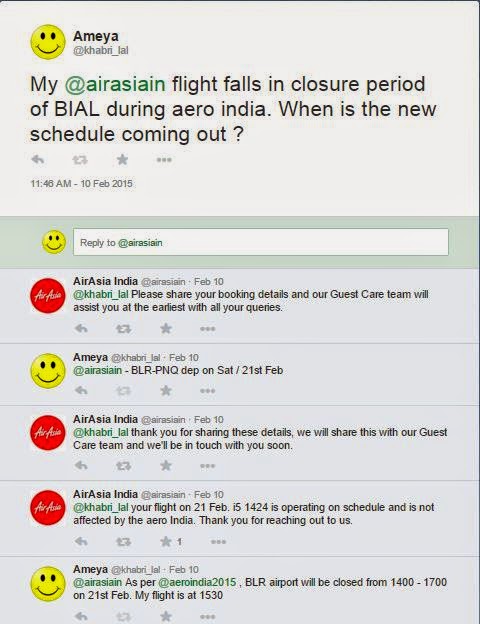
I tweeted tagging Air Asia asking if the flight would change. Since Pune airport is closed on all Saturdays from 1100 – 1700 hours, I was sure the flight could not be advanced, it can only be delayed. Yet there has to be a confirmation. As all other airlines continued adjusting the timings, Air Asia did not !

My twitter interaction with the Air Asia team was as below,

After this I got a call from Air Asia team in Bengaluru informing me that in no case will the flight be delayed.
Snapshot of information from BIAL website


On the day of departure, I got an email saying that my revised time of departure is now 1700 hours and not 1530. This was expected because the airport operator will have given a new slot to the airline and cancelled its slot in the closure hour.

Wonder why the airline did not initiate information to passengers till the last minute.

Check-In
I reached the airport early keeping in mind the traffic conditions which I experienced since morning at Bengaluru. The airport was deserted due to the closure and quickly made my way to the check in counters which had some rush.

A quick chat with the check-in agent of Air Asia about the delay and I was informed that the airline wanted to advance the flight to before the closure hour and hence the last minute delay. This reason again does not make sense considering the closure at Pune.

Fail #2

Check in was a smooth experience otherwise with boarding card handed over. I headed for security which was a very quick affair because there were no flights departing till 1700.

Airport Renovation
I have always considered BIAL as an air conditioned warehouse building until recently when they went for an expansion. The expansion has been done very well with gates on the ground floor in addition to the contact gates. The renovation is still in progress and some good food options are coming up. It was very nice to see the expansion work in progress and on track.

Soon the airport will start work on second runway and another terminal. Overall it should be good for the city and the airport.

Boarding
This was utterly messed up affair. The airline said that boarding will commence at 1625 hours. The flight had a load of roughly 163 pax and all of them were at the gate by then. As people started queuing up around 1630, the lone staff informed that there will be a delay of 10 mins or so due to the runway still being closed. Now this was always known !

As the queue became longer, there were conversations between the ground staff and somebody either on the ramp or in office about revised timing for Pune departure. Whatever the passengers could hear on the walkie talkie, it created an impression that everybody was clueless on when this flight would depart.

What is surprising is that an aircraft was available in Bengaluru and the airline was not waiting for an aircraft to land before they can board this flight.

The ground staff kept on delaying boarding, even as two busses of Air India waited for the passengers to board. Finally the staff informed passengers that the runway is still closed and just when the sentence ended, JetAirways B737 took off which led to some cheers and jeers from the waiting passengers.

Slow boarding commenced and we made our way to the aircraft as more and more people came in. I was seated in seat 8F and from what I saw, the baggage loading had completely stopped for a while which led to further delay.

Eventually doors closed at 1743 hours, a good two hours 13 minutes from the scheduled time of departure and 43 minutes from the revised time.
Fail#3

Inflight and meal
The pilot came on PA to apologize for the delay and this was followed by a safety demo while we taxied past Kingfisher and Blue Dart aircraft and lined up on active runway 09 to take off before another Air Asia bird bank left and set course for Pune.

The aircraft was clean, the seats very comfortable as compared to the slim seats of IndiGo and the seat belts neatly arranged. Bright red color of the seat belt along with the black leather seats is a great color combination.

Inflight service started soon. With the cabin crew coming with a tray to passengers who had pre-booked their meals. This makes a huge difference. Couple of points to ponder here for the market leader IndiGo
  • Air Asia allows you to choose the exact meal and not a veg or non veg option like IndiGo 
  • This ensures that you get exactly what you have ordered unlike in IndiGo where one has to still go through the lucky draw process. Even with a pre booked meal, your choice may not be available.
  • You get served first before the on board sales commence.
  • Hot Meals! 

These four factors are huge differentiators for Air Asia India and when the expand between Metro routes, could tilt the balance in favor of them especially of the corporate passenger.

The meal was tasty, filling and cheap! This was one case where the taste and cost in air is comparable to that on ground.

The airline should do everything possible to highlight this as part of its sales strategy.
#SuperWin

Deplaning
We landed smoothly on runway 28 at Pune and parked at Gate 2. The pilot came on PA informing the cruising altitude of 36000 feet and the outside temperature of -45 degree C. The airline could also announce the outside temperature at destination post landing. Just a additional brownie point.

I did not have any check in luggage but while I walked till the baggage belts, the luggage had started arriving, which is very fast and commendable.

Overall verdict
The airline will give tough fight to the competition if it gets it operations in order. While this was my first flight, I have read about the delays from a lot of friends and also some news items in the newspapers here in Pune. The delay experience was certainly something which has not been handled well.

I would give full marks to inflight – seating, comfort, service and food.

Now the last question – Will I fly again? I will, but not immediately. I will wait for the operations to stabilize and have more positive feedback on this before I book again.

Also, with the fog season behind us, the airline operations to the north should stabilize and February – May On time performance will be a good parameter to judge the airline.

Flight Summary
I5 – 1424 Bengaluru to Pune
STD: 1530, RTD: 1700; ATD: 17:55
STA: 1700, RTA: 1830, ATA: 19:05
Aircraft: VT-RED
MSN: 5824 Airbus A320 with Sharklets. Operated before as 9M- AQW


Saturday, February 7, 2015

Baby Steps to 2017 - Jet Airways declares profit after seven quarters

This article has been jointly written by Prathamesh Kini & Ameya Joshi

Aviation industry in India is noticed more for wrong reasons than for the good reasons and thus Spicejet made most of the news in the last quarter. What the industry missed out on was the constant growth in share price of Jet Airways – in a quarter traditionally considered good for the industry and in the case of Jet Airways – the one in which it shifted to a full service model.

Net profit was a foregone conclusion since the airline had already announced that amount received by the sale of Jet Privilege – the frequent flier program, will be shown in tranches. The eyes were thus set on operating profit.

As late last evening Jet Airways announced results, it indeed report a wafer thin operating profit, its first after seven consecutive quarters of losses. Improvements came all across, however there continued to be some areas of concerns.

The airline reported an overall profit of INR 63 Cr for the third quarter of FY14-15. For the past 9 months, the airline now stands at a loss of INR 84 Cr with very slim chances of closing the year on a profitable note. The airline continued to post proceeds from the sale of Jet Privilege Frequent Flier Program to Etihad as part of its balance sheet this quarter.

The results of Q3 have a lot of positives, with the foremost being an impressive 11.5% increase in Total revenues taking it to INR 5051 Cr on a Y-o-Y basis. The operations are now sustainable on the back of this climb in revenues and lower cost due to decrease in fuel cost (11% reduction in expenditure Y-o-Y). Total Expenses have increased by 5.4% to Rs. 5014.5 Cr. y-o-y, aided primarily by drop in fuel costs and a stable currency exchange. Going forward, these costs will stabilize based on outlook for global oil prices and Indian economy. However the conversion to full service model, advertising its umpteen runs to Abu Dhabi from across the country and fleet conversion has come at a cost – which has led to an increase of expenditure by 42.8% Y-o-Y to INR 502.1 Cr.

Its time to cheer for specialists looking to make a career in Aviation, as the airline saw addition of manpower, taking the headcount to 12,897 employees an addition of 9.3%. It is good to see an operating profit of INR 36.6 Cr. (without income from Sale & Lease Back). When your core operations start making money, the signs are always bright for shareholders! This reminds of a Guy Finley quote 'Being fully present is the best guarantee for a bright future'.

While it was always believed that the investment by Etihad would be used to retire old high cost debt, the interest component paid up has reduced by just 1.6% to INR 226.4 Cr on absolute terms and this should be a concern in the longer run. However, most of this is offset by  operating profit and income from Sale & Lease Back which stands at INR 219.7 Cr. This situation should temporarily ease frayed nerves of the lenders. With a positive outlook on economy for the next few quarters, the airline looks on track to achieve an operating profit in 2017 as it has aimed for. This will come at the back of fixed or decreasing interest dates since income from Sale & Lease back will not continue for long.

Without exceptional items, the company has posted a loss of Rs. 6.7 Cr. which seems a lot more positive as compared to losses of Rs. 235.2 Cr. in Q2FY15 and Rs. 289.0 Cr. in Q3FY14. The overall rejig and stability at Jet Airways has been cheerful for the shareholders too, with Earning Per Share of INR -9.4 for the three quarters of FY15 as compared to INR -167.3 in the corresponding period last year.

Passenger growth has been phenomenal at 13.8% led by fare sales but growth in revenue has been 10.6% with RASK growing 1.7% Y-o-Y. The combined effect has led to a drop in average gross revenue per passenger by 2% to INR 8504.

While the company has managed to achieve break-even load factors (including exceptional items), in the long run we believe that the company should release break-even load factors without exceptional items, since they will not be a permanent feature on the P&L.

Jetlite operations
The operations continue to be a drag on the balance sheet. While operations are being reduced progressively that had led to a reduction of 17.5% departures yet an improvement in load factor to 82.7%, the break-even load factor continues to be very high at 97.3%. The average revenue per passenger is a meagre INR 4433, almost half of that of the parent.

The reason for the lower average revenue is also due to the sectors on which Jetlite aircraft are operating at the moment. Slowly but surely, the sub brand will be phased out and if that is going to take time, the aircraft would be repainted to remove brand confusion.

Points to Smile
  • Profits are profits and even a marginal one is a good beginning
  • 10.4% increase in passengers carried
  • Seat factor up by 5.2% to 82.1% almost equal to break-even load factor
  • Exponential increase in code share traffic

Points to ponder
  • Overall FY14-15 will be a loss when Q4 results are declared
  • Q4 is considered weak and a resurgent Spicejet will initiate a lot of sale and offers
  • Vistara is expanding on key Mumbai – Delhi route
  • Q4 will be first full quarter with Full Service Model 

Way Forward
The airline is now focusing on domestic as well as international operations. Reduction in services by Spicejet would have helped grow yields since the network overlaps at multiple stations. The shift to Full service will also distinguish itself from market leader IndiGo – which continues to grow rapidly. Vistara will take time to catch up country wide and the dual fleet strategy of Jet Airways will continue to feed its network at major metro’s.

The airline intends to return to absolute profitability till 2017 and we believe that the balance sheet will continue to be black till then, either by showing the money received on account of the strategic sale of Jet Privilege or later on Sale & Lease Back transactions.


The airline could now place an order for a mix of B737MAX and ATR72-600. Standardization is a major problem which the airline needs to come up with sooner or later. With the SAARC and Middle East flights on Narrowbody – the customer experience is paramount when competing with modern widebodies from competitors.  


Analysis of the results of last quarter can be found here

Wednesday, February 4, 2015

Fiasco at induction - what went wrong when the Q400s landed ?

A lot is being written and discussed about Spicejet and its strategy for dual fleet. While a parallel is being drawn with successful western carriers to push forward the argument of a single fleet, the successful western carriers – RyanAir, EasyJet or Southwest operate in an environment which has umpteen airports with supporting infrastructure for the B737 or A320 family unlike India where there would only be a handful of airports and most of which have some or the other constraint.

Personally, I believe the differentiator for Spicejet always was to have a dual fleet and move from a pure play LCC to a value based LCC which will help passengers reach airports which are not covered by market leader IndiGo and is cheaper than Full Service carrier Jet Airways.
The question that needs to be asked is – Was Q400 right for Indian conditions or the proven ATR72 would have been a better bet? Going by the teething troubles for the Q400 and the engineering issues which the airline is believed to have faced – yes the proven ATR72 would have been better.

If the promise to do one more flight a day than the ATR72 cannot be met because the operator needs a break in schedule in the middle of the day for engineering reasons, the spending on Q400 is not justified.

Today I am going to take a look at what went wrong at the time of induction of the Q400s and how the legacy cost which the current management has to handle is in addition to the legacy deals and aircraft like the Q400.

This only highlights how important fleet selection is, in addition to planning the network and pricing your tickets.

What exactly went wrong with the Q400?
A realization had dawned upon Spicejet after the first set of aircraft were to arrive in India that at all places where ATR-72s operate, a Q400 may not operate? And why is that so?
In April 2012, I had written a piece on the induction of Q400s by Spicejet on this blog.

What had I not mentioned in this article was the lack of planning while inducting the Q400s. When the schedule was initially filed, regulatory authorities rejected the filing for quite a few airports and expressed inability to support the Q400 operations.

The answer lay in the Airport Rescue and Fire Fighting Services (ARFF) category. At a length of 32.84m and a fuselage diameter of 2.89m, Q400 required Category VI firefighting equipment at airport as compared to category V of ATR 72 with a length of 27.2m and 2.57m fuselage diameter.

The difference is huge, since Category I – V required one vehicle for ARFF and Category VI & VII require 2 vehicles. This meant that while Q400 could operate to airports like Jaipur, Indore, Bhopal, Lucknow and many others which see regular narrow body operations, it could not operate to Dharamshala, Allahabad, Gorakhpur and many others which saw ATR 72 operations and were potential stations for the Q400. The story was same in the south, with Rajamundry, Vijaywada having similar problems.

So the Q400s started with operations to town and cities which saw narrow body operations by other carriers and the planned shock and awe of induction and expansion had to wait.
This certainly would have hit the revenues since typically the revenue on competitive routes is lesser at unit basis than those to monopoly or duopoly routes where the airline intended to fly. Besides, the whole marketing idea of taking on the ATR by a faster Q400 did not take place since the Q400 started competing with the B737s or A320s which are preferred by passengers over the turboprops.

Unfortunately, I have not had a chance to fly the Q400 ever and thus I will not comment on how the aircraft fares with the ATR from the user experience perspective but will only hope that the airline gets a good deal to continue using the Q400s and develop a unique model between the Full Service carriers and the market leader!


Wednesday, January 14, 2015

Revised Policy on 5/20 and Route Dispersal Guidelines

 Last week the Ministry of Civil Aviation (MoCA) discussed revised policy on regional connectivity with all stakeholders and came up with a middle path to address the issue which has been awaiting reforms for a long time.

In 2012, a leading consulting firm submitted report to MoCA on revamping the existing Route Dispersal Guidelines (RDG) but these suggestions were never implemented. The government now is looking to club the famous 5/20 rule with RDG. This comes at a backdrop of airlines making full use of Regional Airline policy with Air Costa scaling up operations, Air Pegasus setting up shop soon and Air Asia India – working like a regional airline operator.

New proposals in classification of airlines

The new proposal looks at abolishing the Regional Scheduled Airline status to an airline and converting it to a regular scheduled airline status. Currently, the regional status is helpful in the south, where Air Costa operates and Air Pegasus is coming up. This policy gives access to one metro in the area and other non metros across the country, except for south where an airline has access to Hyderabad, Chennai & Bengaluru, making it possible to fly in the golden triangle in the south.

This proposal also looks at creating three categories viz. Scheduled Airlines, Scheduled Commuter Airlines and Charter Operations.

The scheduled commuter airlines and charter operations will see reduction in paid up capital – thus encouraging newer entities to set up businesses. These operators would be allowed to publish their schedule and would have a cap on minimum number of movements per week to continue holding this status with a restriction of operating at one metro airport only.

The scheduled commuter airlines will be allowed to enter into a code share arrangement with a scheduled airline, thus making it viable for smaller airplanes to fly on thin routes and get paid for by the larger airlines who will shy away from plying here, but continue to provide seamless connectivity, including baggage and passenger transfers at major airports.

Route Dispersal Guidelines

When the Revised draft of Civil Aviation Policy was released in November’2014 I had written on how the Route Dispersal Guidelines (RDG) need to be looked at in detail and what changes are essential. The blog post is available here. I am not sure if the letter was read by the ministry or not, but a lot of things have been incorporated in the revised policy in line with the recommendations which I had sent. 

Category - I
The number of Cat – I routes increased from 12 to 26, where the additional 14 routes are those which saw traffic of more than 5 lakh passengers in 2013. The additional routes are – Mumbai – Goa, Mumbai – Ahmedabad, Delhi – Lucknow, Delhi – Pune, Delhi – Ahmedabad, Bengaluru – Pune, Mumbai – Kochi, Bengaluru – Hyderabad, Hyderabad – Chennai, Delhi – Patna, Mumbai – Jaipur, Delhi – Goa, Chennai – Pune, Mumbai – Chandigarh. ( Cities in BOLD are those which were not part of Cat I before)

I am surprised to see continuation of Mumbai – Trivendrum into Cat – I. Interestingly, IndiGo has maximum presence on the list of routes proposed for inclusion in Cat – I and is a capacity leader on most of the routes, if not all.

Category – II
The existing definition would continue, with routes connecting North – Eastern region, J&K, Andaman & Nicobar and Lakshadweep but there is a proposal to add Dehradun, Shimla, Kulu & Dharamshala to this list.

Currenly, only Dehradun supports narrowbody operations and Shimla & Kulu are restricted to ATR-42 operations with load restriction.

Currently, an airline has to deploy 10% of Category – I ASKMs on Category II routes. The proposal if accepted would mandate the airlines to deploy 20% of Category – I ASKMs on Category – II routes.

Category – II A
The existing definition of this would continue the way it is with inter – Category II flights considered for calculation of ASKM and it being mandatory to operate 1% of Category I ASKM in Category II A.

However, the flights get restricted to inter north east and between Jammu – Srinagar – Leh since there is no other airport in Andaman & Nicobar which is open for commercial operations or at Lakshadweep.

Category – III
Currently it is mandatory for airlines to operate 50% of Category – I ASKMs on Category – III routes. This condition will be dropped completely in the new policy. Traditionally airlines have been making money on these routes and offer more than double the mandatory ASKM’s.

Revision of 5/20 rule

The famous 5/20 rule refers to requirement of 5 years of domestic operations and a fleet of 20 aircraft to be eligible for international operations. As newer airlines like Air Asia India and Vistara entered Indian market, there is renewed push and focus on this requirement. While there is a valid argument that an airline which starts operations in foreign land can fly to India in its first year of operations, subject to bilateral arrangements, Indian carriers cannot reciprocate this due to this rule.

While Spicejet has scaled back operations to international stations in recent past, IndiGo has not expanded beyond certain routes and infact discontinued flights on certain sectors in the past.

The 5/20 rule will make way for a prima facie complex system which will be based on Domestic Flying Credits (DFC) which will be earned by airline by deploying capacity on domestic routes

The calculation would be as below,
       1)      Deployed ASKMs in updated Cat – I  ( x 1)
       2)      RPKMs deployed in updated Cat II ( x 3)
       3)      RPKMs deployed in updated CAT IIA ( x 5)
       4)      ASKMs deployed in updated CAT III  ( x 1)

There will also be a grant of 5 times the ASKMs deployed on currently un serviced airports for a period of 5 years. This will be exclusive for an operator along with having Right of First Refusal for 2 years from the start of operations.

The domestic flying credits thus accumulated will allow an airline to offer equivalent ASKMs on international routes. These criteria will be applicable to new airlines and new routes of existing airlines when the policy comes into effect.

The differentiation of ASKMs ( Available Seat Kilometers ) and RPKMs ( Revenue Passenger Kilometers ) is well thought out for the above calculation.

Change in criteria

The change in criteria would mean that the existing rules of 5 years of operation will be over ridden by requirement of minimum 200 crore DFC for designation as an international carrier and the fleet size requirement of 20 is reduced to 5, which is the minimum prescribed to get a scheduled airline status.

The policy also allows purchase of DFCs from another airline to gain the status quickly. This will get the rule from 5/20 to 1/5.

Comments

This policy is a sensible shift from existing to the new by factoring in remote connectivity, international operations and creating a balance between the two. Established airlines will face issues with the revision of Category – I routes and fulfilling revised ASKM criteria. However, with cities like Pune, Lucknow and Goa seeing rapid expansion of traffic over the last decade and half, it was prudent that these cities and certain routes from here would be included in the revised definitions.

This proposal looks viable and acceptable as compared to dealing with the RDGs and 5/20 rule in isolation 

Monday, January 12, 2015

From Lohegaon to Sonegaon & back on IndiGo’s A320

2014 ended with very few flights for me, yet I went to some new places, flew new airlines and aircraft. Even before the year was to end, I had booked for a short trip to Nagpur for a wedding, followed by a short family holiday in Tadoba Tiger Reserve. As always the trip had some last minute scare due to work, but I made it!

Trip Planning & Flight History– The first of many favorite parts of a trip
We booked the ticket in October’14.  The sector has traditionally seen flight operations from IndiGo. If my memory is right, the airline started basing its second A320 in Pune sometime in October 2009, with base departures to Chennai – Kolkata with one aircraft and Nagpur – Delhi with another. In 2013-14 when the airfield saw closure due to MAFI (Modernization of Airfield Infrastructure) project of Indian Air Force, the schedules were changed and when the airfield opened for normal operations, IndiGo chose to continue its base departures to Chennai and Kolkata – thus starting a non-stop Kolkata flight, terminating the early morning Nagpur flight.

Currently, Go Air flies an early morning departure to Nagpur, which operates as Bengaluru – Pune – Nagpur – Kolkata in the morning and reverse in the evening along with two departures of IndiGo, first at 11:05 and the later at 18:25.

In the past, Jet Airways has tried this route, when they operated a Pune – Nagpur – Indore and vice versa routing on a B737 (Kolkata – Mumbai – Pune – Nagpur – Indore and return) and prior to that Kingfisher had a popular Nagpur – Pune connection via Indore on ATR-72

Booking
It was a breeze as usual on the official IndiGo website. Hassle free, with options of choosing seats, meals and excess baggage – none of which was booked by us.

Few days prior to the flight, I checked what the availability of seats is, most of the paid seats were snapped up, which meant the chances of getting emergency row or first row was rare, so I purchased the seats.

Airport Information
Enough has been covered in my previous trip reports about Pune and hence I will update only the latest. The canopy structure is now complete, so vehicles now come in and stand underneath the canopy. Also complete is a building in the old parking area, which was supposed to house ticketing offices and Air Asia has been allotted space there, the rest of the airlines are protesting to move there. The hangers meant for private jets parked in Pune are in final stages of completion.

Nagpur Airport – famous for the over a decade old MIHAN project now has a Work in progress hanger which will soon be for Air India MRO along with 7 bays and one operational runway – 14-32 which is 10500 feet long. The airport has been renamed as Dr.Babasaheb Ambedkar International Airport in 2005 from its earlier name of Sonegaon.

Rotation
IndiGo’s two A320s parked at Pune typically operate as Pune – Chennai – Pune – Nagpur – Delhi – Goa – Delhi – Bengaluru (Subject to change once it reaches its hub in Delhi) and Pune – Kolkata – Dibrugarh – Kolkata – Ahmedabad – Pune – Nagpur – Delhi, making it easier to predict the registration a day in advance !

Pune – Nagpur is a distance of 605 kms ( 800 announced by the pilot) which is scheduled to be covered in 1hour and 20 minutes. The flight would typically fly overhead Aurangabad (IXU) before setting course for Nagpur. 

The return rotation typically works as Delhi – Vadodara – Delhi – Kolkata – Dibrugarh – Kolkata – Delhi – Nagpur - Pune

Pune - Nagpur
Check-in & Airport Experience
We reached the airport well in time for our 1825 departure. The cab situation in Pune has improved after Meru cabs entered the scene. Quickly going through the standard CISF – double check at Pune, we made our way to a quick baggage screening and to the counters of IndiGo. An IndiGo aircraft was pushing back for Delhi – their 5th daily and another (VT-IDD ex-Tiger Air) was at the bay waiting to go to Bengaluru as 6E-105.

Check in was quick and pleasant, followed by a very quick security as we went and waited at the first floor departure gate. No new options have been added in terms of shopping or eating at this level.

Unfortunately there was no air force activity in this clear winter weather as we waited for our flight to arrive from Ahmedabad.

Boarding & In-flight
The incoming aircraft landed before time at 1750 hours from Ahmedabad (AMD) and docked at bay 4. About 100 passengers seemed to have got down at Pune. I hurried to stand first in queue so that I could find a place for cabin luggage as well as see the loads on AMD-NAG sector.


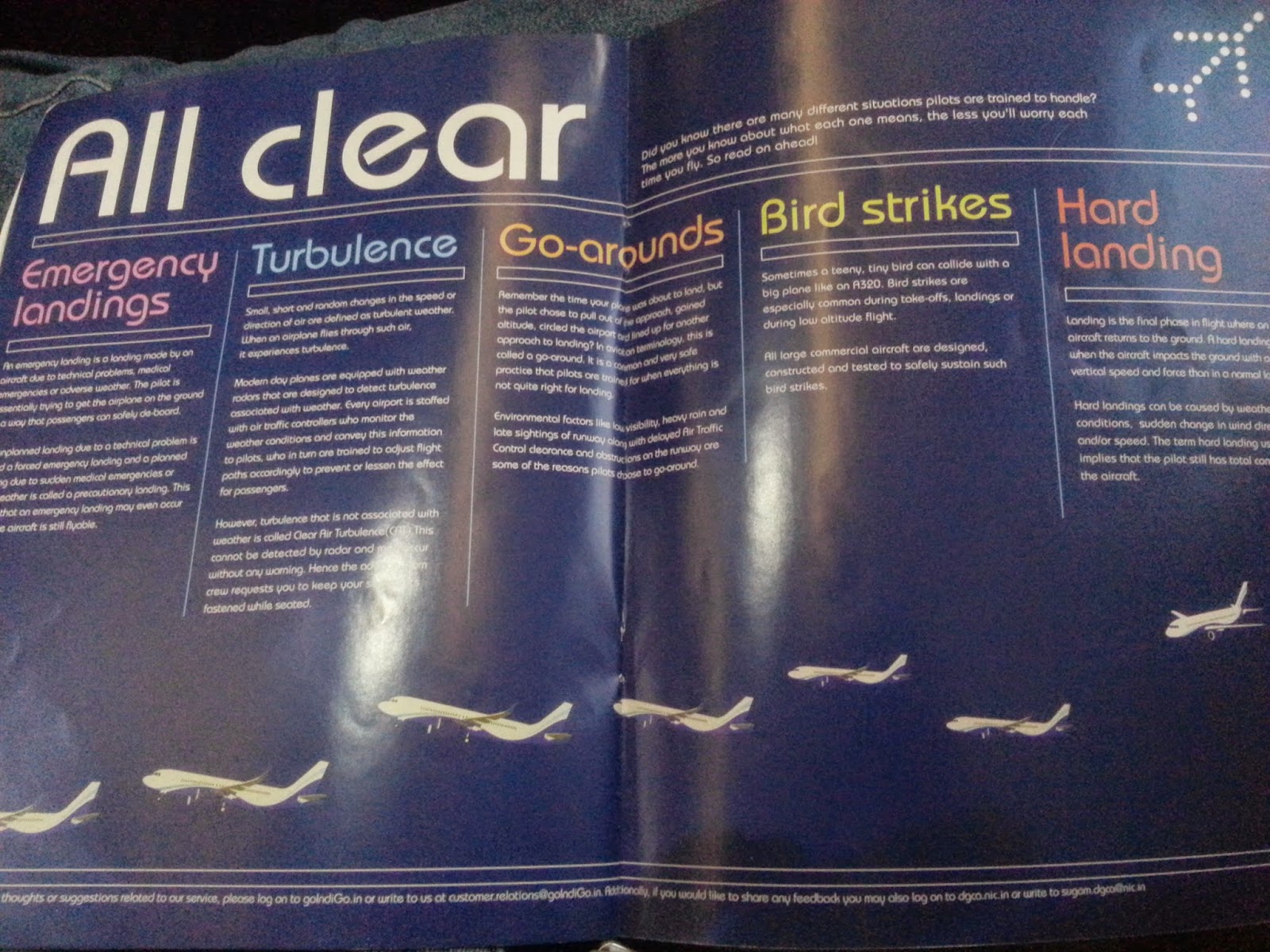
Hello 6E had this interesting information
Boarding commenced at 1805 and was done in the next 5-7 mins, helped by light load of 78 pax boarding at Pune with around 25 already inside the aircraft transiting. That is indeed a very light load of just over 50%!

As we made ourselves comfortable, IFE Poonam briefed us on the safety procedures since we were seated on the emergency exit row and the reason why I’m mentioning the name here is because these were the most crisp and clear instructions I have ever had in over 50 flights which I Have sat on the emergency exit row. Indeed the airline should ensure that the IFE trains their other crew for this.

Doors closed at 1812 and we pushed back at 1815 for a long taxi to runway 28. The instructions by the crew were very clear except for one part where the crew mentioned that Capt. Peter was from Czechoslovakia. Well, he can either be from Czech Republic or Slovakia! It would be a 1:15hr journey to Nagpur. Vacant premium seats were available on sale inflight.

As we taxied out, my wife wondered if IndiGo has taken my last Trip Report seriously and stopped announcing समयपर रहना अनिवर्य है”/“ Samay par rehna aniwarya hai” ( It is mandatory to be on time). I wondered that too since there was no announcement to this effect. 

We waited for an 9W ATR to land (arrival from Indore) and were cleared to taxi on active, where we made a powerful westwards takeoff from runway 28 at 1820, banked right headed to Nagpur.

Service started soon after we stabilized and I saw that the non-veg options have substantially reduced in the menu. We ordered for Corn & Spinach sandwich (Quality improved over last time), Non-Veg noodles (Out of stock) – hence asked for Veg Noodles and two coffee.


Cockpit crew did not announce the flight details like altitude, speed and route in-flight but Capt.Devraj, the First Officer came on PA as we started our descent and announced that our ETA would be 1928, 17 mins before schedule and outside temperature being 21 degree Celsius with clear skies.

We landed before time on runway 32 and went till the end to turn and park at one of the aerobridges. The airport is a huge building with flights concentrated at few times, like many other airports.

Deplaning & Baggage
The baggage was quick to come out and the staff was around to check if we are taking our own baggage or not. We were out in no time being welcomed by infinite horns at the airport and chaos that ruled the exit lanes.


Nagpur – Pune
Check-in & Airport Experience
We reached Nagpur airport, fairly early for the 2145 departure, which I was sure would depart early. As we entered, we saw crowds boarding flights for Mumbai, Bengaluru, Kolkata, Pune on IndiGo, Air India and Go Air.

Check-in was quick and pleasant experience but the security lines were long and we waited for lines to be cleared before we crossed Security. The Security Hold Area (SHA) is divided into ground floor and first floor sections. I think Nagpur is the only airport, where I have purchased a bottle of water for Maximum Retail Price (MRP)

Boarding & In-flight
The incoming flight arrived at 2105 and about a 100 passengers deplaned before row wise boarding was announced and enforced. We boarded in the second lot and made our way to the emergency exit row. The briefing on emergency procedures seemed dull and not up to the mark, obviously compared to the inbound flight.

Hello 6E was missing from my seat
Boarding was complete for this flight which had about 12 empty seats and push back commenced at 2134 as we taxied to runway 32 and were airborne at 2041. Capt. Puneet Kaushik was in command with First Officer Capt. Dhillon for this 800 km journey which was announced to take an hour and 10 minutes. We banked left and set course for Pune cruising at FL340 (34000 feet).

Between boarding and push back – came the twist, the familiar and amusing announcement in auto mode - समयपर रहना अनिवर्य है”/“  followed by समयपर रहना महत्वपुर्णा है”/Samay par rehna mahatwapurna hai” ( It is important to be on-time)
Now I am confused on why this was not played in the inbound flight ! Standardization anybody ?
Inflight service was quick owning to this time of the day not being the perfect time for Buy on Board. We asked for two cups of coffee which were promptly delivered.

The pilot came on PA and announced the commencement of descent (somewhere over Aurangabad) at 2215 and expected time of arrival being 2240. A steep descent later,  we flew in really smooth with flaps extended, reduced thrust as we made a feather touch landing on runway two-eight at Pune at 2234 and exited the runway after light braking to reach the bay at 2235. This indeed was one of the best landings I have had for a long time!

Deplaning & Baggage
The step ladder at the rear took a lot of time to come thus the majority of the crowd rushed towards the forward exit as we deplaned and made our way to Baggage belt 4 to collect our luggage. As we walked towards the arrivals gate, VT-GOQ of Go Air taxied in followed by a Jet Airways aircraft.

Overall Rating
Booking – 5/5
Web Check in / Website – 5/5
Airport Experience – 5/5
On-Time – 5/5
In-Flight service 4/5 (Inconsistent)
Meals – 3/5 (Still needs improvement)