Wednesday, January 14, 2015

Revised Policy on 5/20 and Route Dispersal Guidelines

 Last week the Ministry of Civil Aviation (MoCA) discussed revised policy on regional connectivity with all stakeholders and came up with a middle path to address the issue which has been awaiting reforms for a long time.

In 2012, a leading consulting firm submitted report to MoCA on revamping the existing Route Dispersal Guidelines (RDG) but these suggestions were never implemented. The government now is looking to club the famous 5/20 rule with RDG. This comes at a backdrop of airlines making full use of Regional Airline policy with Air Costa scaling up operations, Air Pegasus setting up shop soon and Air Asia India – working like a regional airline operator.

New proposals in classification of airlines

The new proposal looks at abolishing the Regional Scheduled Airline status to an airline and converting it to a regular scheduled airline status. Currently, the regional status is helpful in the south, where Air Costa operates and Air Pegasus is coming up. This policy gives access to one metro in the area and other non metros across the country, except for south where an airline has access to Hyderabad, Chennai & Bengaluru, making it possible to fly in the golden triangle in the south.

This proposal also looks at creating three categories viz. Scheduled Airlines, Scheduled Commuter Airlines and Charter Operations.

The scheduled commuter airlines and charter operations will see reduction in paid up capital – thus encouraging newer entities to set up businesses. These operators would be allowed to publish their schedule and would have a cap on minimum number of movements per week to continue holding this status with a restriction of operating at one metro airport only.

The scheduled commuter airlines will be allowed to enter into a code share arrangement with a scheduled airline, thus making it viable for smaller airplanes to fly on thin routes and get paid for by the larger airlines who will shy away from plying here, but continue to provide seamless connectivity, including baggage and passenger transfers at major airports.

Route Dispersal Guidelines

When the Revised draft of Civil Aviation Policy was released in November’2014 I had written on how the Route Dispersal Guidelines (RDG) need to be looked at in detail and what changes are essential. The blog post is available here. I am not sure if the letter was read by the ministry or not, but a lot of things have been incorporated in the revised policy in line with the recommendations which I had sent. 

Category - I
The number of Cat – I routes increased from 12 to 26, where the additional 14 routes are those which saw traffic of more than 5 lakh passengers in 2013. The additional routes are – Mumbai – Goa, Mumbai – Ahmedabad, Delhi – Lucknow, Delhi – Pune, Delhi – Ahmedabad, Bengaluru – Pune, Mumbai – Kochi, Bengaluru – Hyderabad, Hyderabad – Chennai, Delhi – Patna, Mumbai – Jaipur, Delhi – Goa, Chennai – Pune, Mumbai – Chandigarh. ( Cities in BOLD are those which were not part of Cat I before)

I am surprised to see continuation of Mumbai – Trivendrum into Cat – I. Interestingly, IndiGo has maximum presence on the list of routes proposed for inclusion in Cat – I and is a capacity leader on most of the routes, if not all.

Category – II
The existing definition would continue, with routes connecting North – Eastern region, J&K, Andaman & Nicobar and Lakshadweep but there is a proposal to add Dehradun, Shimla, Kulu & Dharamshala to this list.

Currenly, only Dehradun supports narrowbody operations and Shimla & Kulu are restricted to ATR-42 operations with load restriction.

Currently, an airline has to deploy 10% of Category – I ASKMs on Category II routes. The proposal if accepted would mandate the airlines to deploy 20% of Category – I ASKMs on Category – II routes.

Category – II A
The existing definition of this would continue the way it is with inter – Category II flights considered for calculation of ASKM and it being mandatory to operate 1% of Category I ASKM in Category II A.

However, the flights get restricted to inter north east and between Jammu – Srinagar – Leh since there is no other airport in Andaman & Nicobar which is open for commercial operations or at Lakshadweep.

Category – III
Currently it is mandatory for airlines to operate 50% of Category – I ASKMs on Category – III routes. This condition will be dropped completely in the new policy. Traditionally airlines have been making money on these routes and offer more than double the mandatory ASKM’s.

Revision of 5/20 rule

The famous 5/20 rule refers to requirement of 5 years of domestic operations and a fleet of 20 aircraft to be eligible for international operations. As newer airlines like Air Asia India and Vistara entered Indian market, there is renewed push and focus on this requirement. While there is a valid argument that an airline which starts operations in foreign land can fly to India in its first year of operations, subject to bilateral arrangements, Indian carriers cannot reciprocate this due to this rule.

While Spicejet has scaled back operations to international stations in recent past, IndiGo has not expanded beyond certain routes and infact discontinued flights on certain sectors in the past.

The 5/20 rule will make way for a prima facie complex system which will be based on Domestic Flying Credits (DFC) which will be earned by airline by deploying capacity on domestic routes

The calculation would be as below,
       1)      Deployed ASKMs in updated Cat – I  ( x 1)
       2)      RPKMs deployed in updated Cat II ( x 3)
       3)      RPKMs deployed in updated CAT IIA ( x 5)
       4)      ASKMs deployed in updated CAT III  ( x 1)

There will also be a grant of 5 times the ASKMs deployed on currently un serviced airports for a period of 5 years. This will be exclusive for an operator along with having Right of First Refusal for 2 years from the start of operations.

The domestic flying credits thus accumulated will allow an airline to offer equivalent ASKMs on international routes. These criteria will be applicable to new airlines and new routes of existing airlines when the policy comes into effect.

The differentiation of ASKMs ( Available Seat Kilometers ) and RPKMs ( Revenue Passenger Kilometers ) is well thought out for the above calculation.

Change in criteria

The change in criteria would mean that the existing rules of 5 years of operation will be over ridden by requirement of minimum 200 crore DFC for designation as an international carrier and the fleet size requirement of 20 is reduced to 5, which is the minimum prescribed to get a scheduled airline status.

The policy also allows purchase of DFCs from another airline to gain the status quickly. This will get the rule from 5/20 to 1/5.

Comments

This policy is a sensible shift from existing to the new by factoring in remote connectivity, international operations and creating a balance between the two. Established airlines will face issues with the revision of Category – I routes and fulfilling revised ASKM criteria. However, with cities like Pune, Lucknow and Goa seeing rapid expansion of traffic over the last decade and half, it was prudent that these cities and certain routes from here would be included in the revised definitions.

This proposal looks viable and acceptable as compared to dealing with the RDGs and 5/20 rule in isolation 

Monday, January 12, 2015

From Lohegaon to Sonegaon & back on IndiGo’s A320

2014 ended with very few flights for me, yet I went to some new places, flew new airlines and aircraft. Even before the year was to end, I had booked for a short trip to Nagpur for a wedding, followed by a short family holiday in Tadoba Tiger Reserve. As always the trip had some last minute scare due to work, but I made it!

Trip Planning & Flight History– The first of many favorite parts of a trip
We booked the ticket in October’14.  The sector has traditionally seen flight operations from IndiGo. If my memory is right, the airline started basing its second A320 in Pune sometime in October 2009, with base departures to Chennai – Kolkata with one aircraft and Nagpur – Delhi with another. In 2013-14 when the airfield saw closure due to MAFI (Modernization of Airfield Infrastructure) project of Indian Air Force, the schedules were changed and when the airfield opened for normal operations, IndiGo chose to continue its base departures to Chennai and Kolkata – thus starting a non-stop Kolkata flight, terminating the early morning Nagpur flight.

Currently, Go Air flies an early morning departure to Nagpur, which operates as Bengaluru – Pune – Nagpur – Kolkata in the morning and reverse in the evening along with two departures of IndiGo, first at 11:05 and the later at 18:25.

In the past, Jet Airways has tried this route, when they operated a Pune – Nagpur – Indore and vice versa routing on a B737 (Kolkata – Mumbai – Pune – Nagpur – Indore and return) and prior to that Kingfisher had a popular Nagpur – Pune connection via Indore on ATR-72

Booking
It was a breeze as usual on the official IndiGo website. Hassle free, with options of choosing seats, meals and excess baggage – none of which was booked by us.

Few days prior to the flight, I checked what the availability of seats is, most of the paid seats were snapped up, which meant the chances of getting emergency row or first row was rare, so I purchased the seats.

Airport Information
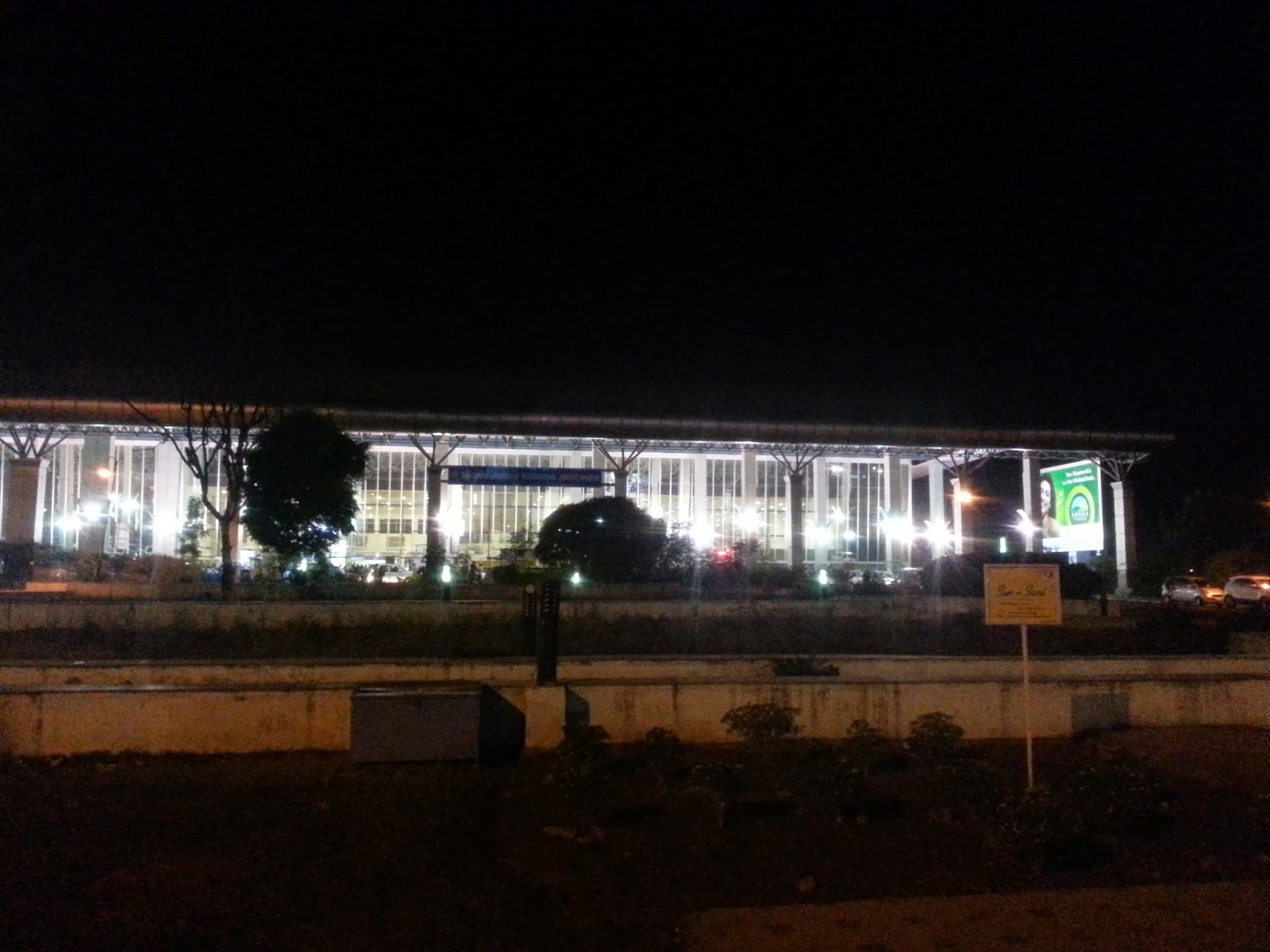
Enough has been covered in my previous trip reports about Pune and hence I will update only the latest. The canopy structure is now complete, so vehicles now come in and stand underneath the canopy. Also complete is a building in the old parking area, which was supposed to house ticketing offices and Air Asia has been allotted space there, the rest of the airlines are protesting to move there. The hangers meant for private jets parked in Pune are in final stages of completion.

Nagpur Airport – famous for the over a decade old MIHAN project now has a Work in progress hanger which will soon be for Air India MRO along with 7 bays and one operational runway – 14-32 which is 10500 feet long. The airport has been renamed as Dr.Babasaheb Ambedkar International Airport in 2005 from its earlier name of Sonegaon.

Rotation
IndiGo’s two A320s parked at Pune typically operate as Pune – Chennai – Pune – Nagpur – Delhi – Goa – Delhi – Bengaluru (Subject to change once it reaches its hub in Delhi) and Pune – Kolkata – Dibrugarh – Kolkata – Ahmedabad – Pune – Nagpur – Delhi, making it easier to predict the registration a day in advance !

Pune – Nagpur is a distance of 605 kms ( 800 announced by the pilot) which is scheduled to be covered in 1hour and 20 minutes. The flight would typically fly overhead Aurangabad (IXU) before setting course for Nagpur. 

The return rotation typically works as Delhi – Vadodara – Delhi – Kolkata – Dibrugarh – Kolkata – Delhi – Nagpur - Pune

Pune - Nagpur
Check-in & Airport Experience
We reached the airport well in time for our 1825 departure. The cab situation in Pune has improved after Meru cabs entered the scene. Quickly going through the standard CISF – double check at Pune, we made our way to a quick baggage screening and to the counters of IndiGo. An IndiGo aircraft was pushing back for Delhi – their 5th daily and another (VT-IDD ex-Tiger Air) was at the bay waiting to go to Bengaluru as 6E-105.

Check in was quick and pleasant, followed by a very quick security as we went and waited at the first floor departure gate. No new options have been added in terms of shopping or eating at this level.

Unfortunately there was no air force activity in this clear winter weather as we waited for our flight to arrive from Ahmedabad.

Boarding & In-flight
The incoming aircraft landed before time at 1750 hours from Ahmedabad (AMD) and docked at bay 4. About 100 passengers seemed to have got down at Pune. I hurried to stand first in queue so that I could find a place for cabin luggage as well as see the loads on AMD-NAG sector.


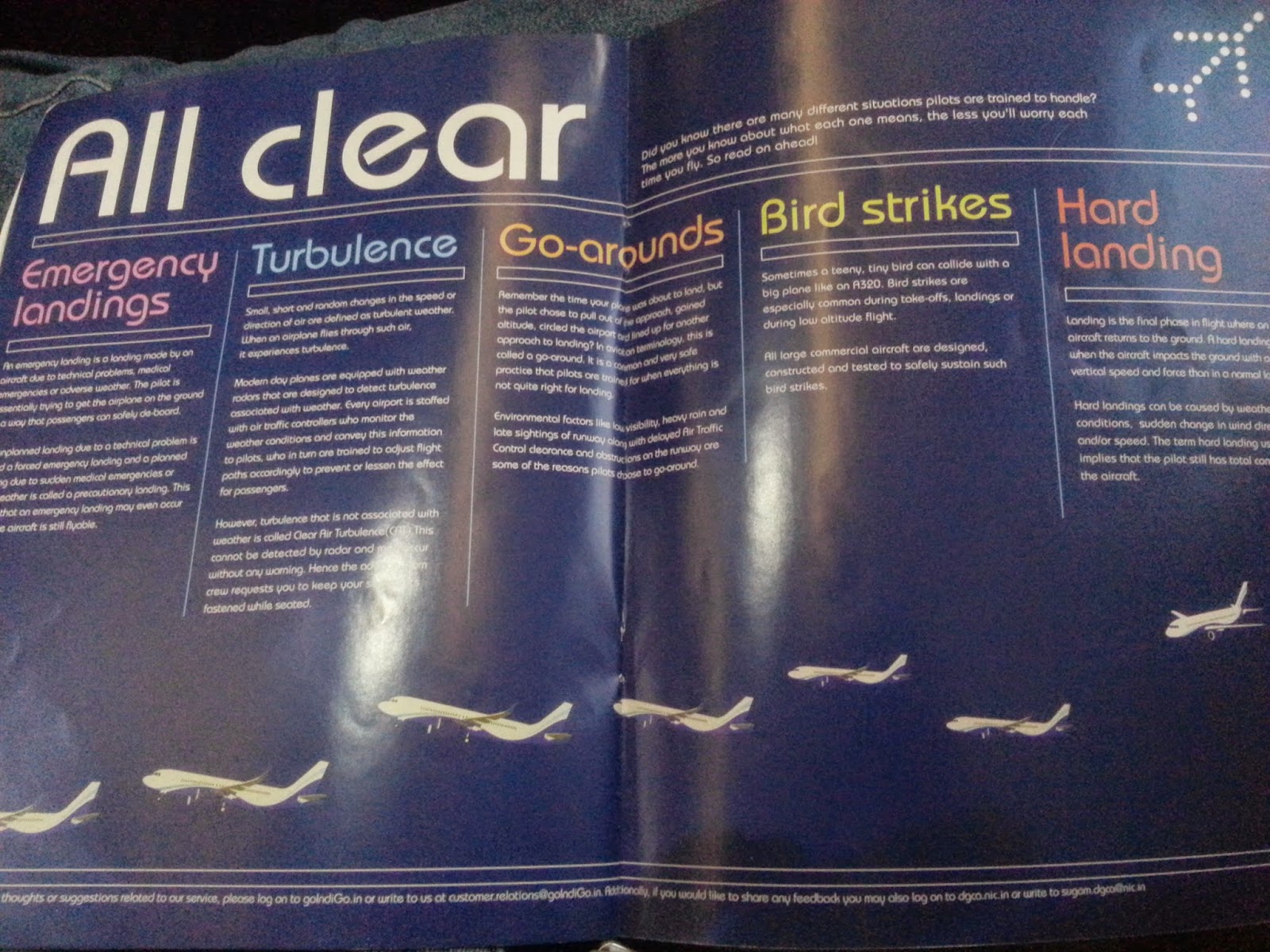
Hello 6E had this interesting information
Boarding commenced at 1805 and was done in the next 5-7 mins, helped by light load of 78 pax boarding at Pune with around 25 already inside the aircraft transiting. That is indeed a very light load of just over 50%!

As we made ourselves comfortable, IFE Poonam briefed us on the safety procedures since we were seated on the emergency exit row and the reason why I’m mentioning the name here is because these were the most crisp and clear instructions I have ever had in over 50 flights which I Have sat on the emergency exit row. Indeed the airline should ensure that the IFE trains their other crew for this.

Doors closed at 1812 and we pushed back at 1815 for a long taxi to runway 28. The instructions by the crew were very clear except for one part where the crew mentioned that Capt. Peter was from Czechoslovakia. Well, he can either be from Czech Republic or Slovakia! It would be a 1:15hr journey to Nagpur. Vacant premium seats were available on sale inflight.

As we taxied out, my wife wondered if IndiGo has taken my last Trip Report seriously and stopped announcing समयपर रहना अनिवर्य है”/“ Samay par rehna aniwarya hai” ( It is mandatory to be on time). I wondered that too since there was no announcement to this effect. 

We waited for an 9W ATR to land (arrival from Indore) and were cleared to taxi on active, where we made a powerful westwards takeoff from runway 28 at 1820, banked right headed to Nagpur.

Service started soon after we stabilized and I saw that the non-veg options have substantially reduced in the menu. We ordered for Corn & Spinach sandwich (Quality improved over last time), Non-Veg noodles (Out of stock) – hence asked for Veg Noodles and two coffee.


Cockpit crew did not announce the flight details like altitude, speed and route in-flight but Capt.Devraj, the First Officer came on PA as we started our descent and announced that our ETA would be 1928, 17 mins before schedule and outside temperature being 21 degree Celsius with clear skies.

We landed before time on runway 32 and went till the end to turn and park at one of the aerobridges. The airport is a huge building with flights concentrated at few times, like many other airports.

Deplaning & Baggage
The baggage was quick to come out and the staff was around to check if we are taking our own baggage or not. We were out in no time being welcomed by infinite horns at the airport and chaos that ruled the exit lanes.


Nagpur – Pune
Check-in & Airport Experience
We reached Nagpur airport, fairly early for the 2145 departure, which I was sure would depart early. As we entered, we saw crowds boarding flights for Mumbai, Bengaluru, Kolkata, Pune on IndiGo, Air India and Go Air.

Check-in was quick and pleasant experience but the security lines were long and we waited for lines to be cleared before we crossed Security. The Security Hold Area (SHA) is divided into ground floor and first floor sections. I think Nagpur is the only airport, where I have purchased a bottle of water for Maximum Retail Price (MRP)

Boarding & In-flight
The incoming flight arrived at 2105 and about a 100 passengers deplaned before row wise boarding was announced and enforced. We boarded in the second lot and made our way to the emergency exit row. The briefing on emergency procedures seemed dull and not up to the mark, obviously compared to the inbound flight.

Hello 6E was missing from my seat
Boarding was complete for this flight which had about 12 empty seats and push back commenced at 2134 as we taxied to runway 32 and were airborne at 2041. Capt. Puneet Kaushik was in command with First Officer Capt. Dhillon for this 800 km journey which was announced to take an hour and 10 minutes. We banked left and set course for Pune cruising at FL340 (34000 feet).

Between boarding and push back – came the twist, the familiar and amusing announcement in auto mode - समयपर रहना अनिवर्य है”/“  followed by समयपर रहना महत्वपुर्णा है”/Samay par rehna mahatwapurna hai” ( It is important to be on-time)
Now I am confused on why this was not played in the inbound flight ! Standardization anybody ?
Inflight service was quick owning to this time of the day not being the perfect time for Buy on Board. We asked for two cups of coffee which were promptly delivered.

The pilot came on PA and announced the commencement of descent (somewhere over Aurangabad) at 2215 and expected time of arrival being 2240. A steep descent later,  we flew in really smooth with flaps extended, reduced thrust as we made a feather touch landing on runway two-eight at Pune at 2234 and exited the runway after light braking to reach the bay at 2235. This indeed was one of the best landings I have had for a long time!

Deplaning & Baggage
The step ladder at the rear took a lot of time to come thus the majority of the crowd rushed towards the forward exit as we deplaned and made our way to Baggage belt 4 to collect our luggage. As we walked towards the arrivals gate, VT-GOQ of Go Air taxied in followed by a Jet Airways aircraft.

Overall Rating
Booking – 5/5
Web Check in / Website – 5/5
Airport Experience – 5/5
On-Time – 5/5
In-Flight service 4/5 (Inconsistent)
Meals – 3/5 (Still needs improvement)


Monday, January 5, 2015

Smart Cities - easy to propose, difficult to implement

On 29th December 2014, the Prime Minister had extensive consultations on the Smart City initiative with officials of Ministry of Urban Development (MoUD). The consultations focused around basic infrastructure, quality of life and waste & water management amongst others.
It is an uphill task to implement changes in urban civic life, till the citizen themselves do not change. Hundreds of regulations, rules, and facilities later if I will still get dirty looks and honks from vehicles behind me when I stop at a red signal, the entire exercise will be futile. However, the effort is worth applauding and I will continue to hope that things will change in the country for better.

JNNuRM – the first smart city initiative?

Then Prime Minister Manmohan Singh unveiled a scheme for rejuvenation of urban centers in India in December’05 and named it after India’s first prime minister. The Scheme titled “Jawaharlal Nehru National urban Renewal Mission” (JNNuRM) was to focus on city modernization with investments exceeding $18 billion over a period of seven years. The scheme has since been extended for a period of two years.

The aim of the project was to have economically productive, effective and efficient urban centers and involved upgradation of social and economic infrastructure of the cities.

While most of us know JNNuRM as a scheme for local buses and transportation initiatives, since most of the buses in the city have JNNuRM written on them, the scheme includes focus on water supply and sanitation, solid waste management, road network, redevelopment of old city areas and urban transport.

The urban transport part envisioned channeling funds via urban development bodies and state governments and roping in private operators on a Built, Operate & Transfer (BOT) model or a Build, Own, Operate & Transfer (BOOT) model.

A total of 67 cities were included in JNNuRM categorized into A, B and C based on 2001 census. The large scale implementation continues to be a challenge, with innovative methods like mid-term appraisal.

The primary focus point continued to be on public transport, since most of the 67 cities either did not have public transport or they had a very inefficient and old system in place.

Smart Cities – the next step

31% of total population in India is urban, but this contributed 60% of GDP and this number will only increase from here on. The smart cities initiative revolves around these numbers where in satellite townships are envisioned around major metros and existing mid sized cities are converted to smart cities.

Smart City is being thought out as a city which has employment and investment opportunities, with good quality of life with adequate infrastructure, public transport, housing, sanitation and water resourced to make it competitive. This will come with 24x7 electricity supply, clean air, quality education, cost efficient healthcare, dependable security, entertainment, sports and connectivity with other cities in the region.

One major factor which is included in this initiative is “Governance”. Governance by incentives rather than governance by enforcement – a concept alien to India, is being factored into this initiative.

Which City can be a smart city?

The laid out guidelines state that the 100 cities selected would be based on the combination of below parameters

·         One satellite city of each of the cities with a population of 4 million people or more (9 cities)
·         Most of the cities in the population range of 1 – 4 million people(about 35 out of 44 cities)
·         All State/UT Capitals, even if they have a population of less than one million (17 cities)
·         Cities of tourist, religious and economic importance not included in above (10 cities)
·         Cities in the 0.2 to 1.0 million population range ( 25 cities)

While this selection was limited to population under JNNuRM, Smart City initiative has made it stringent. The norms include the below amongst others,

  •       Have an existing master plan or one that is likely to be approved shortly and have such a validity of at least 10 years.
  •          Have digitized spatial and GIS maps
  •          Transparent and time-bound procedure of granting free right of way for laying optic fibre networks, water supply lines, sewerage systems        and other utilities (Not more than 7 working days).
  •          Create an IT-based platform for effective communication with the citizens and keep them abreast of various activities and plans of the city.


Smart Cities – Transportation aspect

After years of neglect, transportation is in focus in the country and Smart Cities will focus on public transport – Metro, Bus, Monorail along with Improvements in infrastructure – building of new roads, ring roads and exploring other modes of transport like waterways.

The maximum time for travel between two points is planned to be 45 minutes in larger cities and 30 minutes in smaller cities. This will have to be achieved by having dedicated bus corridors or successful implementation of Bus Rapid Transit System (BRTS) or quick implementation of metro across cities, an option which involves higher cost. This transport network has to have high frequency and should be accessible within 800 meters (walking time < 10 mins) in densely populated areas, along with access to para-transit.

Such systems can be achieved only when there is multi modal transportation available, with a mixture of busses whose schedule is in sync with that of the metro and busses across multiple routes feed into a metro station in the area which then transports people across the city, a system which has been perfected in Singapore, Dallas and Barcelona.

The fragmented and project based approach of JNNuRM will be replaced with a proper planning based and holistic approach with citizen engagement wherever necessary.

How will smart cities be financed?

The biggest challenge for any initiative is financing it. The local governing bodies are not cash deficit and the state governments are in similar situation. With rising deficit at central level, newer ways have to be devised to fund these projects, which are estimated to cost Rs. 35,000 Crore per year and the government plans to have a mix of Public-Private partnership as well as Viability Gap Funding (VGF).

While 60% of the funds will be used on infrastructure, 10% will be earmarked for e-governance.

Implementation Challenges

While funding can be earmarked, critical areas can be isolated and vendors can be identified, the regular pain point of Implementation will be the biggest challenges and all the more so because of the new ways, means and methods of implementing such a large scheme. While the scheme involves participation from people, something which has never happened in the past, the citizens themselves may not be aware of such activities and/or a lot of citizens will come up with multiple suggestions/issues which have a serious threat of delaying the implementation.

The Implementation of the scheme revolves around multiple stages of planning starting with Citizen Reference Framework, Smart City Development Plan and Environmental Sustainability Plan.

Concluding notes


While JNNuRM was the first scheme in the last as many years to look at infrastructure development in city, the scheme tried addressing age old issues and challenges, while Smart City initiative is one of the first schemes which looks as capacity building for the future and hence stands out. 

Friday, December 5, 2014

Air Canada returns to New Delhi effective November’15

In an unexpected announcement, Air Canada (IATA code AC) announced resumption of services to New Delhi (IATA code: DEL) beginning November’15. (Winter Schedule-2015). The flights will be operated by B787 Dreamliner aircraft, and the press release claims this will be the first route with the longer range B787-9, which will operate on two of three weekly services proposed by the airline.

The airline will operate this non-stop service four times a week,
Flight
From
To
Depart
Arrive
Days of the week
AC050
Toronto
Delhi
20:55
21:15 (+ 1 day)
Monday*, Wednesday, Friday, Sunday
AC051
Delhi
Toronto
00:45
05:00
Tuesday, Wednesday*,Thursday, Sunday
Departure from Toronto on Monday & from Delhi on Wednesday will be operated by B787-800.

Historic and current links to Canada
While Air India operated Amritsar – Delhi – Toronto flight, the same was pulled out owning to heavy losses in May’12. Air Canada also,in the past operated flights on the Toronto – Delhi sector. Both the airlines had flown this route with the B777 variants and Air Canada will benefit from the favorable economics of the B787 over the B777.

Currently only Jet Airways operates a flight to Toronto, via its hub at Brussels from Delhi, with connections from Mumbai.  With talks of Jet Airways shifting its hub from Brussels to Amsterdam or to Abu Dhabi, the future of flights to Toronto would be in question.

B787 – Dreamliner
The aircraft has its share of problems across the globe, including with Indian national carrier Air India. While Air India has two class configurations, Air Canada has configured its Dreamliner’s (B787-800 variant) in three class configurations with 20 Business, 21 Premium Economy and 210 Economy class seats. The Star Alliance member is yet to reveal the configurations of its longer B787-900 variant.  

While the B787-900 will have wingspan and fuselage same as those of the -800 variant, it is expected to be longer by 6 meters and higher Maximum Take Off Weight (MTOW), with a range of 15372km, compared to 14500km of the smaller B787-800 variant.

Delhi Hub & Connectivity
Not long ago, Star Alliance had made intentions clear about having a hub at Delhi along with Mumbai. Clearly the entry of Air India in Star Alliance is helping Delhi develop itself as a hub, along with attracting global traffic.

As per existing schedules of Air India, the inbound flight would connect to multiple destinations
Inbound
Connection Time
Destination
1 - 3 hours
Mumbai(AI), HongKong(AI), Bangkok(TG)
3 - 6 hours

6 - 9 hours
Ahmedabad(AI), Lucknow(AI), Pune(AI)
9+ hours
Khatmandu(AI), Hyderabad(AI), Chennai(AI), Kolkata(AI), Kochi(AI)

Outbound
Connection Time
Destination
1 - 3 hours
Chennai(AI), Mumbai(AI), Ahmedabad(AI), Kochi(AI), Kolkata(AI), Bangkok(TG)
3 - 6 hours
Singapore(SQ), Pune(AI), Hongkong(AI), Lucknow(AI)
6 - 9 hours

9+ hours


Re-timings would help Air Canada connect both ways to Singapore on Singapore Airlines, while it would already connect to Bangkok on Thai Airways – both Star Alliance members.

Concerns
While this new link is a welcome move, the traffic between Canada & India has remained stagnant for a while. The traffic patterns are mainly seasonal and there are ample options available via Europe, Middle East & the USA.


Resistance of Canadian government to grant more rights to Middle Eastern carriers and requirement of US visa for transit would benefit this non-stop service of Air Canada. 

Tuesday, December 2, 2014

Jet Airways shift to Full Service, how are the Jetlite flights being managed?


On 11th August in a joint press conference with Etihad, Naresh Goyal, Chairman of Jet Airways announced the shift to a Full service model. Vistara, the yet to fly full service carrier, a joint venture of Singapore airlines & TATA group and Air India, after its entry into Star Alliance was considered tough competition in the full service space.

The mixed model
As Kingfisher Airlines bought Air Deccan to have presence in growing Low cost segment, Jet Airways bought Air Sahara, then a full service carrier and converted it to Jetlite, a low cost arm of the parent. All the CRJ-200s were retired, the airline pulled out of few sectors and others were converted to ATR flights, which were operated by Jet Airways. Later, a new segment came up, flights which would be called Jet Konnect, which was low cost offering of the mainline. Many aircraft saw decals of “Konnect”, over Jet Airways titles on the fuselage and these were to operate on Tier-II routes. However, as expected, the aircraft flew all across leading to confusion in minds of passengers.

Soon there were rotations, where flights went from Origin to Destination as Full service and returned as Low Cost, carrying food to be given out in the first leg and on return, the crew would sell on board!

First Blink
What options did one have on the service front?
  • Aircraft – Jet Airways metal
    • Business Class & Economy Class Full service
    • Business Class & Economy Class – Buy on Board (BoB) in Konnect
  •           Aircraft – Jetlite (Ex- Air Sahara aircraft)
    •          Business Class & Economy Class – Buy on Board (BoB)Business

As this confusion started affecting the airline, first of many changes were made. This included having premium cabin being served complimentary food, across Jet Airways, Jet Airways Konnect & Jetlite.

The second change involved doing away with Jetlite and having two offerings, Jet Airways & Jet Airways Konnect. This also was confusing for the travelers, because the aircraft operating under Air Operators Permit (AOP) of Jetlite continue to have the light blue livery with Jetlite prominently written on the fuselage.

Just before the shift
Jet Airways was in news for planning to shift ATR fleet to Jetlite and also its plan to shift pilots creating road blocks, issues related to seniority and much more!

Thankfully, common sense prevailed and Jet Airways decided to make a move to Full service offering. The now defunct Kingfisher Airlines, had made a similar statement but it was too late in the survival cycle for them to invest, change and make the move. The airline shifted to what they called a holding pattern and later stopped operations, much before they could complete re-configuration of their aircraft and shift to a full service model.

Code share
With court cases, ruling out a merger between Jet & Jetlite, the airline resorted to code share, a common practice globally, but unique in this case since it is between the airline & its subsidiary. It involves each airline publish and market the flight under its own airline designator and flight number. Seat can be purchased on either of it but the flight is operated by only one, known as operating carrier.

The seat and revenue sharing could be done in multiple ways
  •        Set number of seats are given by the operating airline to its code share partner and the partner airline maintains a separate inventory and sells it. The operating airline gets a fixed cost for sold/ unsold seats

  •        No restriction on seats, where in both airlines open up all seats for sale. There could well be a cap on maximum seats sold under this arrangement

Code share between Jet Airways & Jetlite did have issues for the passengers, since until recently the passengers booked on 9W code with operating carrier being Jetlite were not able to do a web check-in!

Move to Full service
The move to full service on 1st December was a silent affair. An email to frequent fliers, statement on social media and the website jetkonnect.com directing users to jetairways.com was all that happened, along with meals being served on all flights, irrespective of which aircraft the flight was being flown on – Jet airways Boeing, Jetlite boeing or Jet Airways ATR.
However, due to legal disputes, the Jetlite AOP (S2 code) continues to be in operation and there are 4 x B737-700, 5 x B737-800 and 1 x B737-900 which are part of Jetlite AOP and remain in operation. Amongst them, they operate 564 flights a week. As part of this move to full service, the passenger would get complimentary food in these flights, but how is Jet Airways managing the Flight numbers, Inventory and trying to be seen as one airline ?

Complex or Simple – Code share to the rescue
Prima Facie, this is how Jet Airways seems to be managing the move. The airline had said it will throw more light on this before the move, but hardly did it give out the details of the move. The answer to how Jet Airways is managing two Air Operating Permits lies in Code Share.

Readers would recollect how an online booking engine would show flights under 9W code (9W 7xxx) and S2 code when they would search for flights on some sectors where both were operating (Eg: Mumbai – Bhopal – Mumbai or Delhi – Chandigarh – Delhi). The flight times would be same, but there would be marginal fare difference owing to how code share is handled).

After the move on 1st December, entire inventory will be managed by Jet airways code (9W 7xxx) and inventory for S2 code, the original flight number will be zeroed out. For operational reasons, the flight plan, ATC, would continue to consider the Jetlite aircraft as an aircraft operating with S2 code and S2 flight number.

A random search on online travel portals reflects these changes and now you can see only one entry for a particular flight, unlike two in the past.

Way forward
The airline has effectively used Code Share as a tool to make this one brand strategy work. However, the livery remains different for the Jetlite aircraft. They would either be moved (sub leased / leased / sold) to Jet Airways, like it happened with VT-JLJ, a B737-900 with Jetlite and now with Jet Airways or just see a chance in livery from existing light blue to mainline colors to further reduce confusion.

But in a country obsessed with food – the first cut has been made. “Jahaj kaunsa bhi honedo, khana jarur milega jee” (Let there be any aircraft, you will certainly get food)